February 04, 2012

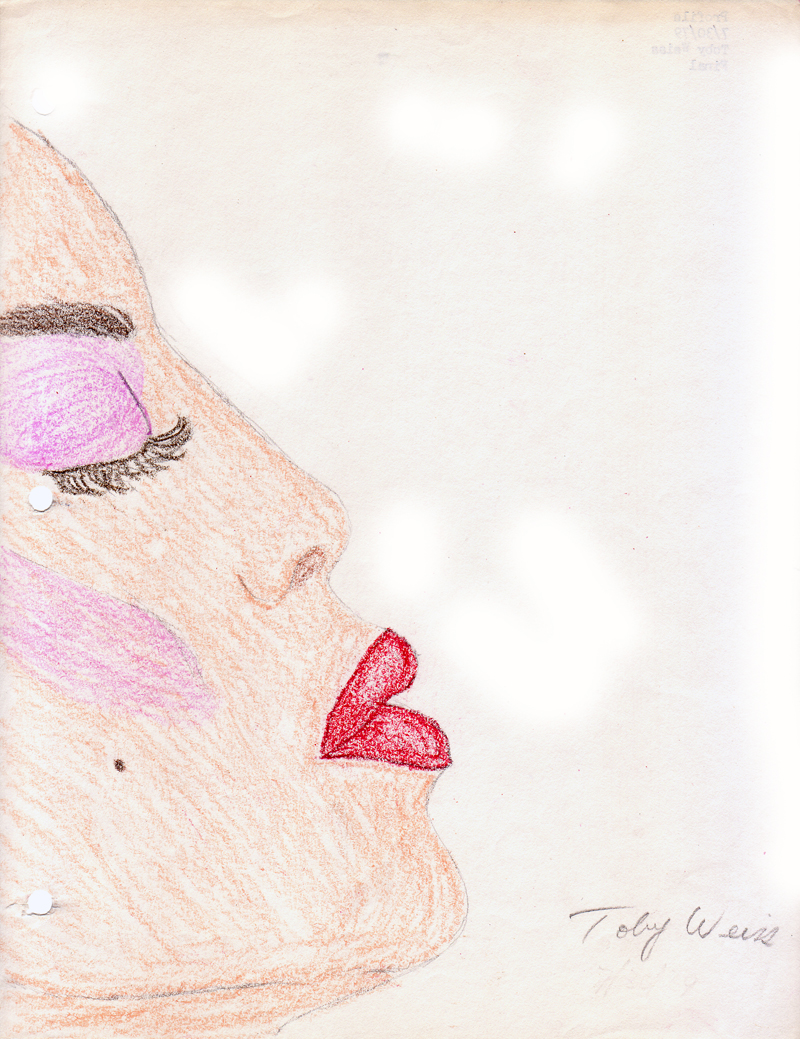
Teenage Scribbles: Debbie Harry


Debbie Harry of Blondie, June 16, 1979
Color pencil on 3-hole punch paper


For every serious music fan, there is that one song, that one moment that completely changes their life. It’s such a dramatic, cinematic scene, that in regards to that event, to classify one’s life as B.C. or A.D. is the only way to convey the religious weight of it.

My personal Jesus appeared before me the first time I heard Debbie Harry sing, “Yeah, riding high on love’s true blueish light/Ew ew oh oh.”

At the time, I was a Casey Kasem Top 40 junkie. From the first moment I heard “Heart of Glass” the very first week it hit the Top 40 chart, my antennae started quivering. I knew the song was trying to be disco but it certainly wasn’t; there was a lot more going on under the covers. And I suddenly remembered all the little bits about Blondie that I’d run across previously in magazines, and I could literally feel pieces falling into place.


Debbie Harry, September 16, 1979
Color pencil on letter bond


I rushed out and bought the single, and actually liked the flip side ten times more. “11:59” was urgent and pleading while the singer’s voice was cool and detached and the dichotomy sucked me under. Plus, the label said “Produced by Mike Chapman.” Oh, man, count me in!

I then rushed out to buy the album, Parallel Lines, and there was no going back. Despite the prejudice of my religious conversion, the cover to that album is still one of the most striking examples of album artwork, simple yet effective, able to convey layers of meaning and style with just a few broad strokes.


Deborah Harry, November 18, 1979
Color pencil on ledger paper


That album sounded like a jukebox full of promise, sounds that I’d heard in various forms before, but were now brought together under one umbrella. I heard “Sunday Girl,” and “Pretty Baby” and thought them just as yummy and hook-filled as any of my childhood AM pop favorites, and they did a cover of a Buddy Holly tune! But I also heard hard, chaotic, frantic sounds that riled me up, like “One Way Or Another,” “Hanging On the Telephone” and “Will Anything Happen?” and I asked myself, “Is this punk rock?” Plus there was a slow, eerie tune with this dead and hollow drum beat (“Fade Away & Radiate”), a song that mentioned watching someone shower, and the very last song on the album telling someone to piss up a rope. “Heart Of Glass” was the lamest thing on the album, and I was ecstatic!

I tapped my alien powers of information gathering for a crash course on Blondie. I found new magazines like Circus and Hit Parader, but it was blast to find Blondie popping up in staples such as People, US and Dynamite. I very quickly learned as much of the Blondie M.O. as possible, had a broad overview of what they were about, what they represented and how they were popular all over the world save for America, where they were deemed too odd, too different, too “punk.” When “Heart Of Glass” hit #1, I was as shocked as I was pleased.


Deborah Harry, March 23, 1980
Color pencil on 3-hole punch paper


Blondie were a new and different world of music, a stranger, more varied world, where not all songs were love songs, where there was subtext and layers of meaning behind every lyric, every riff, and every artistic decision. Blondie was the tree trunk that sent me out onto a thousand branches, where I finally learned about punk (checked out dozens of albums from the library; the Sex Pistols’ debut album didn’t sound like Blondie, so I didn’t care for it, but the Ramones were intriguing), Andy Warhol, CBGB’s, underground art and films, early 60s girl group pop, and that there was a lively, exotic world thriving outside the Billboard Top 40. I learned more about the world of culture within a couple months than I had in my previous 13.5 years. It was heady and addictive.

“Blondie is a group,” and then there was Debbie Harry. Say it again, my bruthas and sistahs: Debbie Harry! Amen.


Deborah Harry, May 1980
Water color on bond paper


She was (and is) a goddess! Aside from Cher, I’d never experienced anyone like her. She was absolutely gorgeous, cooler than shit and had the most glamorous clothes, shoes and hair imaginable. In print, she was intelligent and insightful, but very coy about her past, her private life and her age, which gave her an air of mystery. She and her boyfriend, Chris Stein, created and ran the band, and she was an equal partner in songwriting, presentation and direction. Again, I repeat, I’d never experienced anyone like her; she was so beautiful and powerful and talented that she seemed more like a comic book hero.

Everything I needed to know about life, sex, fashion and music, I looked to Debbie. And because American media was now as infatuated with her as I was, it was easy to get all the advice I needed.


Blondie Was a Group, January 1983
Charcoal on sketch paper


Blondie profoundly altered my viewpoint of the world, and I had the utopian belief that it affected everyone else, too. I’m sure it did in many quarters across the nation, but at Kirby Junior High in north St. Louis County, there was no change at all. When I dared speak to someone else about Blondie, it was a bad topic. If someone wasn’t talking trash about them being a disco band, they were thinking they were too punk, too fucking strange, uncool.

But I knew they were all dead wrong, and the “Us & Them” mind set took firm root in my psyche. I’d unwittingly found a way to further ostracize myself from the peer group, but this time it left me with a whole other – and better – world to explore, football fields of things to think about, which made ignoring everyone so much easier to do. 


D.H. a.k.a. B, April 1983
Charcoal on bond paper


February 03, 2012

Teenage Scribbles: Jean Harlow


Jean Harlow, November 17, 1979
Ballpoint pen & color pencil on ledger paper


8th grade was turning out to be an even bigger abscess than 7th grade, so I needed new distractions. One of them was an obsession with black & white Hollywood movies of the 1930s and 1940s.

I took a quick break from reading every old Hollywood biography I could buy with allowance money or borrow from the library to commemorate my new favorite fellow-Missourian, Jean Harlow.

(Teenage Scribbles = finding a large stash of drawings I did between the ages of 14 - 20, with the vast majority happening before too many drugs, boys & bold misadventures preoccupied my time.)

February 02, 2012

Teenage Scribbles: Suzanne Somers

Suzanne Somers, August 14, 1979
Color pencil on sketch paper

The 4th season of Three's Company would start the following month, so the advance publicity was in gear. Miss Somer's debuted a new hairstyle in all the gossip magazines lying around our home. I felt this was truly noteworthy.

(Teenage Scribbles = finding a large stash of drawings I did between the ages of 14 - 20, with the vast majority happening before too many drugs, boys & bold misadventures preoccupied my time.)

February 01, 2012

Teenage Scribbles: Vogue Magazine

Beads, July 30, 1979
Crayola crayon on 3-hole punch paper


Bored on a summer vacation day, leafing through the July edition of Vogue, getting upset that my puberty-ravaged body had nothing in common with anything on any page.


Profile, July 30, 1979
Crayola crayon on 3-hole punch paper


I used to raid my mother's makeup drawer to try and approximate these looks. Paper was more cooperative than my face, thus I went for the higher success rate.

Special note must be made that the skin tone in this drawing, and the one above, was done with the Indian Red crayon. Political correctness was several years in the future.


Hand, July 30, 1979
Pencil and nail polish on 3-hole punch paper


After a half hour with the crayons, I went high concept by filling in the fingertips with my mother's Avon nail polish. To this day, it still gleams all frosty orange.

Jerry Hall, July 30, 1979
Watercolor on 3-hole punch paper


By the afternoon, I graduated to watercolor. And I was not going to pass up an opportunity to draw Jerry Hall, who - even though she had it made by hooking up with Mick Jagger - was still actively modeling at this time.

Oh, how I loved me the Some Girls album from the summer before. Anything to do with it was glamorous - 'cept for maybe Jerry's nose? Can't help but note that I took some artistic license - the junior high version of rhinoplasty.

(Teenage Scribbles = finding a large stash of drawings I did between the ages of 14 - 20, with the vast majority happening before too many drugs, boys & bold misadventures preoccupied my time.)

January 31, 2012

Teenage Scribbles: Rod Stewart

Rod Stewart, July 24, 1979
Color pencil on 3-hole punch paper


The summer before starting 8th grade, I loved disco. So I was not bothered by "Da Ya Think I'm Sexy?" I even thought that most of the album it came from - Blondes Have More Fun - was pretty damn great.

Later on, I went backwards through Rod Stewart's music catalog and quickly realized why so many were upset. But not before thinking large chunks of Foolish Behaviour was pretty damn great.

RELATED A fictional imagining about THE decisive moment in the downturn of Rod Stewart’s career.


(Teenage Scribbles = finding a large stash of drawings I did between the ages of 14 - 20, with the vast majority happening before too many drugs, boys & bold misadventures preoccupied my time.)


January 30, 2012

Teenage Scribbles: Olivia Newton-John

Olivia Newton-John, May 6, 1979
Color pencil on 3-hole punch paper


I was a hardcore Livvy fan, joining her fan club during the 1976 Don't Stop Believin' era. Things were looking pretty bleak for her - both artistically and chart-wise - come 1977's Making a Good Thing Better. Grease saved her career and gave us all something to obsess over during those last innocent moments before junior high began.

Olivia's Bad Sandy and her (still amazing) album Totally Hot inspired me to makeup my face and hair in an endlessly bittersweet parade of 15th-rate imitations (she always had the best hair, didn't she?). Growing weary of the uphill battle, I finally gave that all up and just drew her, instead.

(Teenage Scribbles = finding a large stash of drawings I did between the ages of 14 - 20, with the vast majority happening before too many drugs, boys & bold misadventures preoccupied my time.)


August 01, 2010

Paul McCartney: Sing the Changes

I like to picture Paul McCartney running across a coffee mug with this old chestnut on it and he chuckles knowingly: “A woman has to work twice as hard as a man to be thought of as half as good. Luckily this is not difficult.”

That quote neatly sums up his career; be it the Beatles or John Lennon, or even George Harrison, he always seems to work overtime to prove that he’s worthy just as he is, constantly battling the qualifiers of his past. In truth, the total output of his entire musical career is staggeringly weighted toward eternal relevance, but it may take two more brand new generational cycles to erase the ever-present “Yeah, he’s great BUT…”

We drove from St. Louis to Kansas City, MO on July 24, 2010 to see Paul McCartney. We were very clear that we wanted to “see a Beatle” while we still had the chance, and on the drive out, we sang along to a few tracks from every Beatle record, and it was glorious. The Beatles are Everything That Is Music to so many of us, and it is a joyous world because of this.


Here’s the set list from that night. Doing the math on what we paid for a ticket divided by how many minutes they played, it broke down to $1.26 per minute, and it was worth even more than that. The band (and if you see them play, you KNOW it’s a true band – and I wish he’d cut a new song or two with them) played 37 songs. 23 were Beatles tunes, 14 were not; it breaks down as 10 Wings, 2 from the 2008 The Fireman record, one 1982 and one 2007 solo Paul tunes.

It was truly transcendent to hear that undiminished voice do “I’ve Just Seen A Face,” “Paperback Writer,” “I’ve Got A Feeling” or “Helter Skelter.” But aside from his tributes to Lennon (“Here Today”) and Harrison (“Something”), the songs that stole my breath and brought tears of joy to my eyes were NOT Beatles tunes. It was 2 Wings tunes (“Nineteen Hundred and Eighty-Five” and “Let ‘Em In”) and The Fireman’s “Sing the Changes” (with a graphic nod to President Barack Obama).

In retrospect, I’m not surprised that Wings tunes plucked my heartstrings; Paul McCartney & Wings were the soundtrack to my grade school 1970s childhood. Same goes for most any early Gen Xer. There were 3 artists that dominated the charts and radio in the ‘70s: Stevie Wonder, Elton John and Paul McCartney. And people our age were pretty much free of The Beatles Baggage that Sir Paul still carries to this day. We reacted to the Wings hits and albums as they happened with a relatively clean slate, and we liked what we heard with no disclaimers.


For those who grew up in the 1960s, disclaimers are all over any of McCartney’s post-Beatles work. Considering how The Beatles changed their lives forever, this is totally understandable. Those 10 years continues to alter the DNA of anyone who hears it, no matter the year or your age. But when only 10 of his 50 years in music were with The Beatles, when does the guy get a break?

Even to this day – even on a 21st century website like allmusic.com – 40 years worth of musical output is still judged against The Beatles, and there always remains the unspoken “Lennon would think this is crap.” But analyzing it in a detached manner, this is a Baby Boomer rock journalist perspective that is being repeated by subsequent generations of music writers, which is really lazy and maddening. It’s especially maddening when all generations’ votes for post-Beatle McCartney via albums, singles and download sales is often dismissed as clueless listeners “falling for” McCartney’s populist pandering (which remains the underlying tone of so many of his solo critiques). It becomes clear that many music writers are trapped in amber, beholden to narratives that will lose resonance as the decades pass. And poor Paul will probably not live long enough to see the day when his entire musical output is justly revered (though nabbing the Gershwin Prize probably soothes a lot of Paul’s wounds).

Of course his entire post-Beatles catalog has low spots; any artist that has been going steady for 40+ years has peaks and valleys. Many times I’ve heard hardcore Bob Dylan and Neil Young fans trashing some of their wonkier albums. But oddly enough, those 2 artists are given a hall pass because when you look at their output as a whole, their levels of consistency far outweigh the momentary lapses of sanity.

But Sir Paul is too often denied that same hall pass by the very same music aficionados. He is rigidly held to an impossible standard that he helped set, and often derided for religiously adhering to a songwriting work ethic, even as they may be haunted by the “du du du du du’s” from “Another Day.”

Considering what he has contributed throughout his entire career, it’s puzzling that McCartney can’t catch a break from a select group of writers and taste-makers of a certain age (and the younger ones who ape their perspective). It’s also puzzling that McCartney is seemingly haunted by this… if you buy into this old narrative.

If you follow the still-popular party line, Lennon and Harrison (and even Ringo) achieved moments of freedom from the oppressive Beatles’ shackles, while Paul continues to run the popular music hamster wheel. Would Paul catch a break if he had taken musical sabbaticals, have public breakdowns, substance issues, or spiritual journeys? Do we need him to be splayed open with misery in order to escape being the lesser in a Beatles compare-and-contrast?

Because it seems that we require our Beatles’ to come down to earth, McCartney had two “opportunities” to rough it up: the death of his wife Linda in 1998 and the sordid divorce trial from Peg Leg in 2008. But rather than show up in a club with a Kotex on his forehead, Paul dealt with his pain through music and by taking the high road. And this may be the rub for many: McCartney is an old-fashioned professional songwriter and performer who keeps his personal life separate from his musical output, which was also the case in the Beatles’ days. He’s been fairly consistent in this manner, but without the protective blanket of The Beatles, he’s been dismissed for the same behaviors and songcraft that was accepted wholeheartedly while in the fold. The double (or triple) standard is, again, maddening.

Wouldn’t you hate to be a Beatle? Wouldn’t you hate to have to live like that? The other three reacted to and tried to move away from that very problem. Paul just seemingly shrugged it off and kept going, unabated. And even though he has given us decades of memorable and hummable songs, it somehow wasn’t enough for the millions of people who still control the narrative.

But that night in Kansas City, for almost 3 hours, we were free of that tiresome narrative. Those of us of all ages were enthralled by everything he gave us, regardless of its pedigree. That’s the power of exceptional songs performed at peak ability: it’s of the moment, of your memories and your emotions. And this does not lessen the impact – there are no disclaimers because this is the truth of right now. Paul McCartney has always written songs for every one of all ages, and this is why – as President Obama noted before handing over the Gershwin Prize for songwriting – McCartney has been on the charts for a cumulative total of 32 years.

It’s ridiculous to divorce McCartney from his Beatles years (and none of us want that, including him!), but it’s equally ridiculous to chain 40 subsequent years of music to The Beatles. Let it be or live and let die, it all matters, and Paul knows this. There is no better protector or curator of The Beatles legacy, and for that he deserves deep gratitude. For everything else, he deserves deep respect. He’s had to work twice as hard to get half of that respect, but for him, that’s not difficult.

RELATED
October 1965: The Beatles - Yesterday
April 10, 1970: The Beatles - Let It Be

September 07, 2009

Details magazine, September 1988

Before Details became a junior GQ, it was the the bible of New York City fashion, culture and party people. For 20-somethings in the Midwest wishing they were in Manhattan, $2 at the magazine stand was cheaper than a plane ticket, and we could be a part of the hip crowd without the threat of not measuring up. It picked up where Andy Warhol left off when he died in 1987.

The ads - like for Gaultier, above - seemed to speak a minimalistic NYC language that was decipherable after a couple of issues, and the cutting-edge designers tended to run different art in Details than they did in the mainstream fashion magazines like Vogue.

But unlike Vogue, they also ran ads from anyone who paid, so the hip was balanced with crap and that underscored the multiple layers of sublime to ridiculous that made the idea of NYC so enchanting.

The NYC clubs - like Odeon, above - or China Club were the destination, providing a shot at hanging in the same building as Matt Dillon or Dianne Brill. Most likely the NYC Club Kids would have blocked someone like me from entering, but I could avoid that embarrassment and still stay in the loop with...

...the best part of every issue, Stephen Saban's party-hopping column, lousy with photos and anecdotes about Cher's Bagel Boy, Rob Camilletti or Keith Richards hanging with 1980s supermodels. Saban knew everyone and dropped trivial facts learned about them while scarfing down free drinks at every cool place in the City. His was the ideal job.

Details had their own fashion issue every September, a decidedly low-rent affair of imperfectly laid-out black & white photos from the runways. This haste and nonchalance about haute couture from Marc Jacobs and Isaac Mizrahi was beyond cool and made this obtuse world much easier to understand. Which also pretty much sums up how Details ladled out NYC to those who couldn't be there.
.

June 25, 2009

Scrapbook: Farrah Fawcett-Majors

The untimely (62 is too young) death of Farrah Fawcett is sad, but knowing in advance that she was dying was deeply distressing. Well before the airing of Farrah's Story, I was keeping track of her condition, awaiting the inevitable. She eventually chose to tell the full story of her cancer journey, and then we knew exactly what kind of living hell she bravely persevered through.

It made me think of Paul Newman, who surely went through the same kind of cancer hell, but he and his family worked hard to hide this from the public, who only had a few brief heads up that he was dying. Because of this privacy, the news of his death became a celebration of his life and accomplishments rather than a study of his terminal illness.

But Farrah made the decision to let us in on the illness phase, and it created a new level of empathy and connection with a lady who was, technically, a stranger. For anyone who has personally experienced family or friends dying of cancer, you know that their death comes as a relief - they are finally free of the pain. So, rather than sadness, I reacted to Farrah's death with a great sense of relief: relieved that she was released from the prison of her own body, and relieved that I could now give up this unusual form of extended grieving for someone I didn't really know.

Turns out millions of us feel like we did know her, as highlighted by the media comments and remembrances by us common folk. The one commentary that struck me the most came from Greg Archer on The Huffington Post because it so closely mirrors my experiences and reactions to those early days of Farrah Mania, especially the parts about getting a skateboard and the scrapbook. Archer had three of them! I only made one, and since it was never thrown away, I can now share some of the pages with you.

Leafing through this nearly-ancient and rotting 3-ring binder has been a touching way to remember Farrah and my 5th grade self, as well as a fascinating study of sudden stardom, media saturation and how the woman at the center of it spent the majority of her life trying to get out from under it.

Because I was a grade school TV junkie, I'd seen Farrah plenty of times. She was Lady Shick, and the Noxema girl, and the Mercury lady who cavorted with a cougar. Because I was a magazine junkie, I knew her as the gal hawking Wella Balsm, Winchester cigars and jewelry. Then she began showing up in magazines like Rona Barrett's Hollywood and Gossip because she was the wife of Lee Majors, which didn't mean all that much to me because I just wasn't a fan of bionic people.

Then in September of 1976, out of nowhere, came Charlie's Angels and BOOM - it was full-time Farrah. Oh sure, the other two Angels were crucially important (I even named my first cat Sabrina): little girls typically never played cops and robbers until the girl detectives burst into our lives, and there being 3 of them made group re-enactment a democratic form of make-believe. But re-creating Roller Derby Angels couldn't get under way until resolving long, intense debates over who got to be Jill.

Jill Munroe being the favorite angel among little girls was not all that mysterious or complicated. Kelly Garrett was impossibly beautiful and sneaky, procuring secret information and suddenly unleashing mad karate; she was dangerous. Sabrina Duncan was cute and brainy, plotting strategy and putting thugs in their place; she was authoritarian.

But Jill Munroe was physical - skating, skateboarding, diving, dancing, jumping and punching - and fearless and friendly and slightly silly. She also had the coolest car, the coolest clothes and would clearly be the most the most fun Angel to hang out with. Jill was like the ultimate big sister and/or the embodiment of what you hoped being an adult would be like.

But Jill was nothing in comparison to Farrah. Everything about her was fresh, abundant and slightly alien, starting with that very unusual name and ending with that hair.

Previous to Farrah, ladies' hair was either meticulously styled and glued into place or stick straight and parted down the middle. Then suddenly, there was bangs and layers and wings and movement; even when standing still, Farrah's hair seemed lifted in a constant breeze. It was a mesmerizing spectacle, compelling most every female of every age to layer their hair and attack it with curling irons and hot rollers to studiously achieve the care-free look.

Previous to Farrah, female sex symbols were curvy and stacked and presented like dolls in a display window. Then suddenly, an athletic build and a healthy glow was sexy and attainable. Farrah wasn't busty (it was more about nipples than cup size) so was unencumbered by a bra. She wasn't hourglass so wasn't confined by tight clothes exaggerating the obvious. Her physical presence conveyed movement, and freedom and fun. Whereas Raquel Welch's cartoonish sexiness elicited women's jealousy, it was easier to approximate and benefit from Farrah's new kind of sex appeal.

Farrah was not classically beautiful. This became apparent when she stood next to Jaclyn Smith, who had the traditionally exquisite kind of face that maybe only .1% of the female population possesses. Instead, Farrah had an energy and charisma that combined with that hair and that smile to project a a new and revolutionary personality.

I remember a Vogue magazine spread with Farrah, wherein the writer revealed that the photo shoot crew were first shocked and then relieved to see her legs were peppered with scrapes and bruises, the true hallmark of an active person. They realized she wasn't perfect and thus adored her even more. Farrah created a new standard of beauty and desirability, and healthy, casual and robust was something every female could realistically achieve. Previously rigid standards of beauty were finally buried.

Her allure was immediately apparent, but that is a job requirement of most Hollywood folk, and instant hit TV shows happen all the time. So what was the key to rapid fire Farrah Mania?

The Baby Boomers had Beatle Mania, and that flash flood cultural revolution was due, in part, to the deft media manipulation of their manager, Brian Epstein. For the Generation X version of Beatle Mania, Farrah's Epstein was Jay Bernstein. And just as most Beatle fanatics knew who Brian was, same went for Jay. I remember a TV Guide article that reported the floor of the pool at his mansion had a mural of the famous Farrah Fawcett poster. He was an important - and fascianting - character in the story of Farrah.

Bernstein had a rare flower and he deftly threw out the seeds, growing dolls, toys, posters, T-shirts, trading cards, lunch boxes and folders.

Books and special edition magazines sprung up like dandelions on the newsstands, and for a generation of young kids attuned to Tiger Beat and MAD, we plucked them with fervor.

For the older folks, Bernstein made sure Farrah was always on the cover of some magazine that reached precise demographics. And if she wasn't a cover feature, her lingering contract with Wella Balsm made sure she would still be somewhere inside every issue of Redbook and Cosmopolitan. Today, it is deeply touching that People magazine did such a wonderful job of documenting all the milestones of Farrah's life.

A key component of Beatle Mania was the distinct look and personality of each Beatle, which made it easy to emulate them by adopting a few key ingredients, like the mop top. Farrah had That Hair, and magazines endlessly shared diagrams of exactly how to get that look. Even though most of us failed spectacularly at achieving the precise Farrah Flip (they warned us that she had very thick hair), it did insert Feathered Hair into the eternal lexicon of hair styles. Even my thin and fine 5th grade hair received a boost from having layers, which is one of the reasons variations of the Farrah 'do will never completely die off.

Once millions of women had approximations of That Hair, what better way to celebrate this achievement than with Farrah Look Alike Contests! For the thousands of new suburban shopping malls springing up across America, there was no better way to bring in customers than to invite ladies' to competitively duplicate Farrah for cash prizes and shopping sprees, and bring along your family and friends.

In North County St. Louis, we had our Farrah Look Alike Contest at the freshly-opened Jamestown Mall. The mother of one of my school mates entered the competition because she felt that her tan, her frosted blond hair with banana curls and her blue eyes made her a sure bet. But as she paraded around the stage in a navy blue one-piece swimsuit smiling so wide her neck veins bulged, it became embarrassingly clear that she'd made a huge miscalculation. For several days afterward, it was difficult for her children to look her in the eye.

The winner of that contest actually did look awfully similar to Farrah, and this achievement earned her local celebrity status for several years afterward. Even better? I ran across this lady at a Famous-Barr department store in the mid-1990s, and she looked exactly the same! In the best possible Whatever Happened to Baby Jane? way, she had preserved every iota of that 1977 Farrah-ness, and considering that Farrah herself couldn't even do it if she wanted to, I about cried with happiness over this demented bit of physical nostalgia.

In August 1977, the overheated race car that was Farrah Mania hit a huge speed bump with the news that she was leaving Charlie's Angels. The emotional and fiscal impact this had would be equal to the absurd notion of The Beatles breaking up in 1965. I wasn't alone in my instant dislike for the newest Angel, Cheryl Ladd.

While the producers of the television show sued Farrah for breach of a non-existent contract (which ended in Farrah returning to the show for 6 episodes during Seasons 3 and 4), Jay Bernstein continued throwing logs into the fire.

The media was still cranking out Farrah magazines, posters and T-shirts.

And new variations of her hairdo were still worthy of cover story placement. See, Farrah was not going away, she just wouldn't be on TV once a week, so there's no need to panic or get angry.

The Farrah PR juggernaut worked all the angles: she left the show because her husband couldn't take it anymore (the Good Wife angle) and they wanted to start a family (the Good Mother angle), and she wanted a chance to become a real actress (the Movie Star angle). So, the focus shifted from her being a phenomenon to wanting to earn the right to be so damn famous by returning to films. A constant stream of news and photos from the set of her new movie mingled with the introduction of The Fawcett necklace.

Somebody Killed Her Husband opened September 1978, and we went on opening weekend to see it. My mother and I went to the movies constantly, and she had long ago stopped restricting me to kiddie films, so I had seen a large number of the movies for adult audiences, and had developed a good critical radar from constant exposure to and passion for movies.

That back story is required for my 7th grade opinion that Somebody Killed Her Husband was actually really good. Even my mother - who did a good job of pretty much ignoring Farrah - liked it. It had an engrossing murder mystery plot, Jeff Bridges was great as usual, and it was easy to overlook that it was "Farrah" because she did a solid job of being "Jenny." I was relieved that the movie worked, and that Farrah had not made a mistake in leaving Charlie's Angels.

Seems I'm the only one who thought that... or saw it. It eventually made its way to VHS (and I liked it even better many years later), but never to DVD. It's a case where bizarrely overblown stardom coupled with relative shock over her career choice created no chance to meet the unusually high expectations for such a small, unassuming film. Maybe her passing will bring about a reassessment of this time period of her work; there's nothing to be embarrassed about with this picture.

But her first flop was no big concern because Faberge unleashed a line of Farrah Fawcett hair care products!

So all the rabid Farrah fans that didn't see Somebody Killed Her Husband still saw her regularly in magazine ads and television commercials for the products. Here's the first commercial, and this is the second commercial.

I instantly noticed that "Majors" had been dropped from her name, and wondered what that was about. But I let it drop because the stuff was really great. I'm not the only Gen Xer who still vividly remembers the smell of the shampoo and conditioner; it was sweet with vanilla underscored by enticing spices.


Come the release of Farrah's second post-Angels film, Sunburn, in August 1979, Farrah Mania was truly past tense. Even I didn't bother to go see it, and have still yet to see it because it never merited much more than an illegal release on Japanese DVD.

And the same goes for Saturn 3, released February 1980, which for me personally wasn't worth the trip to a movie theater because it was a sci-fi flick (same reason I still haven't seen her 1976 film Logan's Run).

During this one-year time period, she separated from Lee Majors (thus the dropping of "Majors" from her name), took up with Ryan O'Neal, and parted ways with manager Jay Bernstein. In retrospect, these were neon signs of a woman forcefully excising oppressive features of her life (husband, manager and fame) in order to figure out what really mattered for her career and personal satisfaction.

In essence, she purposely walked away from it all at the height of crazy fame, making her trajectory not unlike J.D. Salinger or Greta Garbo, but actually more akin to Leonardo DeCaprio recoiling in fear after Titanic, some 20 years later. Yes, she continued to work, but only under her own terms.

Over the years, Farrah has addressed how insane the heightened fame was, and how it instilled a need in her to control her privacy, which usually turned out to be a futile aim despite her best efforts. Because of the speed and impact of her ascendancy, she was forever an icon and would forever fight to keep it in control and in perspective. Her thoughts on the matter are really no different than what has been expressed by all the former Beatles, with the major difference being she checked out from it far sooner and far more successfully than any of them did.

It wasn't until August 1977 that she determined what kind of acting career she wanted, and it took another 7 years for her to hone that talent and finally receive the respect and validation she needed.

Let's not forget that she was, essentially, a good Catholic Girl ( after one divorce, she never remarried and she surely bore the unorthodoxy of an unwed pregnancy in 1985 even more than the general public did), so it's easy to imagine the guilt she felt over undeserved success and fame. What is most deserving of respect and admiration is how drastically she moved to correct it, and how hard she worked to achieve the right balance of personal and professional that would make her comfortable in her own skin.

Her personal journey is another reason she has remained such an intriguing icon to both Boomer and Gen X women. The first quarter of her life was about following the rules, while the rest of her life was about writing and re-writing her own rules. It wasn't always smooth, it wasn't always pretty, but a life lived honestly never is, and if someone as blessed as Farrah - who had no choice but to live it partially in public - could trip, fall and always get back up again,then maybe we could, too. We couldn't have her hair, but we could use her as a barometer and inspiration.

The Golden Girl who always had it all and continuously threw it all away in her search for something true had come to her final chapter. Because of all the previous chapters of her life, she was fully equipped and fully prepared to face the ultimate meaning of her life, which is why her decision to let us in on the most painful, final chapter of her life has such resonance: she had nothing left to fear because naked honesty is the final reward that all spiritual practices aim for, and she finally attained it.

We have all noted the bravery of her final years, but when looking back on her life, that bravery was always there; we just didn't quite see it because of all the trappings of beauty and crazy fame. But even though we didn't acknowledge it until the end, she lived it every day, and she more than validated the reasons why we have been so captivated by her for so many decades. She has earned the rights of her iconic status, and she has earned the right to rest in peace.