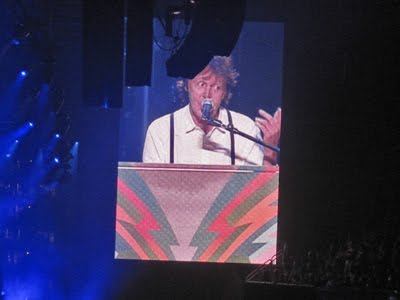
Tom Petty & the Heartbreakers got lumped into New Wave for a bit, maybe because their debut album sounded like such a throwback? That label quickly proved false, but it did lead me to Damn the Torpedoes.
I was blissfully free of any Byrds or Bob Dylan associations, so I took their work at face value, and loved it. Plus, Tom Petty just came off as effortlessly cool, which was a major selling point to someone who was tragically uncool.
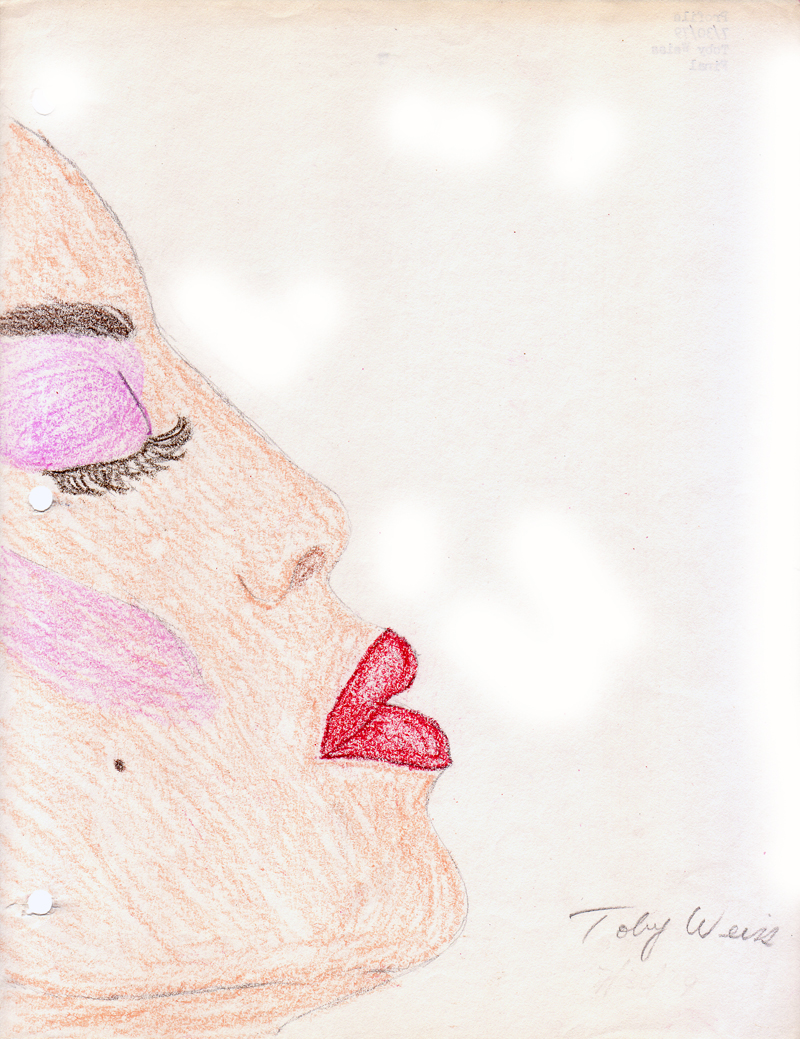
Looking at this old drawing reminded me of someone... who is it? Ah yes, Dale Gribble! No editorial opinion is meant by that.
Stevie Nicks, August 1982 Pencil in sketch book
Since 1975, I've had an intense love/hate relationship with Stevie Nicks. She was given a reprieve from my hatred when she started hanging around Tom Petty, reasoning that someone as cool as him would only hang with other cool people, right? Their relationship resulted in some adultery rumors for Petty's marriage and Stevie's debut solo album, of which I genuinely liked 40% of.
Back in the day, the image of Stevie Nicks was compelling, but the musical output that came from it too often bothered me. I was never a fan of poetic mysticism, save for a few tunes from The Doors. And it bothered me that she got the lion's share of attention in Fleetwood Mac, when it was clear that Lindsey Buckingham and Christine McVie consistently had the goods while Stevie was hit or miss.
A good case in point is the Fleetwood Mac album Tusk. In my mind, the 2-record set is really 3 solo albums. Christine McVie’s songs were faultless, and so organic and seemingly effortless that it was easy to once again take her for granted, rather than praise her as being the most consistently great member.
Then there were Lindsey's songs! I was captivated by the ad hoc feel of his tunes, as if he’d haphazardly thrown a mess of wet noodles on the wall and whatever stuck became a song. They sounded alive and urgent and even when he was pissed off (on something like “That’s Enough For Me”, for instance) it still sounded…fun. “Fun” was never a word one would use to describe any part of Fleetwood Mac, but neither was “alive” and “urgent,” you know? But that’s what I heard coming from him, and at times it seemed like Lindsey was making a jittery new wave record while his bandmates were putting on more cocoa butter to soak up the Southern California sun.
Then there were Stevie's songs. "Sarah" is undeniably pretty. "Angel" remains her best rock moment. But then there was "Sisters of the Moon," which makes me cringe just typing the title.
As soon as I had home-taping capability, I made a cassette of just Lindsey's Tusk songs, with some Christine bonus tracks thrown in. Pointedly, there was no Stevie. And by the time of her second solo album in 1983, I was decidedly anti-Stevie (save for the track "Enchanted"). Turns out Lindsey's production was her emperor's clothing, and here was my editorial cartoon on the matter:
For the Bird, Winter 1983 Charcoal on sketch paper
Jim Morrison, Spring 1981 Felt tip pen and letter stencil on bond paper
Only upon finding this stash of drawings from my teenage
years did I remember how much Jim Morrison once meant to me. The 1980
publication of the Jerry Hopkins and Danny Sugarman book No One Here Gets Out Alive was a conjuring trick that resurrected
the dead. And the first Second Coming of Jim Morrison culminated in his
September 1981 Rolling Stone cover
with a headline forever etched in my brain: “He’s hot, he’s sexy and he’s dead.”
Jim Morrison, August 1982 Pencil in sketch book
While many of The Doors’ singles were still all over the
radio, the book (which I read a total of 5 times in high school – even gave an
oral book report that garnered an A) led to buying and listening to the albums.
Because it was so evocative of the era,
this led to a crash course in 1960s hippie history (Richard Brautigan, Peter
Max, youth rebellion, free love and rampant venereal disease), and I briefly fashioned
myself a modern day hippie. But hippies weren’t as glamorous as, say, The
Warhol Factory, and since both camps did lots of drugs, might as well stick
with The Lower East Side over Woodstock (indoor plumbing always wins).
Come the tragic murder of John Lennon, it was The Doors, The
Beatles and Black Sabbath who got me through that horrible winter of 1980-81.
And come the introduction of marijuana to my world, Jim Morrison’s excess was
an inspiration to scale greater heights of inebriation. He set the example that
constant intoxication can lead to artistic achievement, so under the
ever-present gaze of an American Poet poster on the bedroom wall, I wrote
horrible poetry.
Strange Days, August 1982 Pencil in sketch book
Come the time I had a boyfriend with a terrible liquor
problem, I realized that Morrison de-evolved into a fat, belligerent drunk, and
suddenly, the romanticism of him faking his own death evaporated. And year
after year, Ray Manzarek’s non-stop worship that relived every second of
Morrison’s existence seemed pathetic.And I am still traumatized by this drum poetry reading by John Densmore.
Since 1980, Jim Morrison continues to be a Burnout Rite Of
Passage, like a sexy, psychedelic teddy bear for the Freaks & Geeks years. Walk into any head shop right now, and he’s
up for sale alongside the Grateful Dead and Jimi Hendrix posters.
Jim Morrison, Winter 1983 Scratchboard
But my genuine take away from that phase is two of their
albums: Morrison Hotel and Waiting for the Sun. To my ears, they stand up proud regardless of
historical context or personal memories of Morrison worship… which I forgot I
had till I saw these drawings.
Chrissie Hynde of the Pretenders, March 22, 1980 Pencil on 3-hole punch paper
When I first heard “Brass in Pocket,” it was good enough.
Being high on a New Wave frenzy, I was excited for an album that would probably
be another in a series of Blondie clones, and that was fine by me.
Seeing the debut album cover for the first time at Camelot
Records was exciting; it was just as simple and iconic as the cover of Parallel Lines, but more minimalist. And
that red leather motorcycle jacket and fingerless gloves? It was a lightning
rod for a girl still in the “dress-up” stage of life.
But once the record needle hit the first track on the album
(“Precious”), it was – literally - drop-jaw time. This was so not Blondie new wave fizz – this was some serious rock shit,
with dirty words, dirty thoughts and dirty guitar wrangling that had me miming
an air Telecaster before ever reaching the final track, “Mystery Achievement.”
The impact of that first listen to their debut album still
resonates to this day. It was the songs, the sound, the sequencing of different
emotions. That a girl was at the center of it was just one of many transcendent
points. But let’s focus on Chrissie Hynde.
Chrissie Hynde, May 13, 1980 Watercolor on bond paper
Whereas Debbie Harry was a goddess, Chrissie Hynde was human.
No matter how much makeup and clothing I slapped on, I could never replicate a
millimeter of the Harry aura. But I already had the bangs and too much eye
makeup – throw in some hastily crafted fingerless gloves, buy a leather jacket
and voila! – I could look like a 10th
rate knock-off of my new idol (and that I went to high school dressed like that remains one of the most embarrassing days of my youth).
As much as I needed to be inside the music I listened to, I
had never felt the urge to pick up a guitar until Chrissie. In retrospect, it
feels like an acoustic guitar magically popped into my hand somewhere during
the 3rd listen of side one of the album. In reality, it was a $35
Sears acoustic given by my Mom as a birthday gift the following October. But it
was Chrissie who inspired the need, Nancy Wilson of Heart who seconded the
motion, and that enabled a teenage girl to have the exact same experience as
every teenage boy around her. Gender should not be allowed to rob one of that
heady musical milestone and Chrissie made it seem as natural as getting a
driving learners permit.
Pretenders Space Invaders, October 1980 Pencil and marker in sketch book
Because so much was made of Debbie Harry being A Girl,
Chrissie being One of the Guys had real magic. She was following in the
footsteps of her musical idols – most all of them men – and her being female
never made her reconsider what she could or could not do. That she was able to
accomplish all this without sublimating her natural female tendencies was a
lesson quickly learned. That she did not make an issue of it made it all the
more potent.
In the press, Chrissie wasn’t so much out spoken as honest
about everything. From being drunk and belligerent to being broken-hearted and
vulnerable, she wasn’t a manufactured image, she just was. And none of it would
have meant much for very long if not for those songs and that band of people.
James Honeyman-Scott instantly became my new guitar god,
Martin Chambers made my legs twitch and Peter Farndon was so dreamy. Together,
those 4 were dynamite, and I could empathize with the great thrill it must have
been for Chrissie to be Just One of Those Guys. Which is why the deaths of Honeyman-Scott and Farndon were
such a punch to the gut – it might as well have been the Lynyrd Skynyrd plane
crash for all the destruction it caused to a great rock band.
Chrissie Hynde, August 1982 Pencil in sketch book
Chrissie and Martin recovered and moved on, and had many great
moments. It’s not like Chrissie could have stopped doing the only thing she
ever wanted to do in life. And in the ensuing years, even when she had moments
of musical laziness or misfires, she is always genuine in much the same way
Keith Richards or Iggy Pop are always true to their code. Chrissie Hynde proves
that musical integrity and longevity is not just a Guy Thing, but rather it’s
staying true to what you were born to do.
Tom Petersson of Cheap Trick, November 18, 1979 Pencil on ledger paper
In May of 1979, I was in deep thrall to Rex Smith, so my reaction to Cheap Trick’s “I Want You To Want Me” on Casey Kasem’s Top 40 was only about how catchy the song was. The “cute guys” in this band had been popping up in the teen girl magazines I read, so I knew they mattered more in Japan than here, but see Rex Smith to know why this introduction went no further.
In August, I did my first round of 12 albums for a penny via Columbia House, and Cheap Trick at Budokan was one of my choices. The sound of the shrink wrap coming off this album was, in retrospect, the trumpets sounding my entry into a new world. Inside the album was a 12-page booklet crammed with tons of photos, lyrics and notes from the band. The cartoonishness of Rick Nielsen and Bun E. Carlos intrigued me, but it was The Foxes that stopped me dead. There was no denying the dreaminess of Robin Zander, with that square jaw, big brown eyes and long blonde hair. But the bass player? Dark wavy hair, crystal blue eyes, hairy chest and a ski slope nose, looking like an idealized Michael Sarrazin.
I was practically salivating as I took this in, and wondering “Why the hell are they in teen magazines?” Because these were men – rock & roll men! All this hormonal upheaval and I hadn’t even put the record on the turntable yet!
Robin Zander, December 1979 Pencil on 3-hole punch paper
Other than Sonny & Cher Live, and Judy Garland at Carneige Hall, I’d never experienced live recordings, so hearing hyped-up Jap girls screaming at the bands’ every move was fun and infectious, and then there was the aural onslaught of Cheap Trick’s music. The guitars and bass roared in golden yellow and dark green waves, the drumming was just as precise and exciting as Blondie’s Clem Burke, and Robin Zander’s voice was elastic and powerful. The album replicated one of their shows; not counting Shaun Cassidy in 1978, I’d never been to an honest-to-god rock concert, so this album was like a Cliff Note’s version of what would happen once I finally got to one, which was very helpful.
The songs that captivated me - “Come On Come On,” “Look Out” (still my favorite song on the album), and “Big Eyes” - were flat-out pop songs, but with a tight, rock bombast that I’d never heard before. It sounded like classic early Beatles’ singles on 10 pots of coffee, and I LUVED it!
They were just as revolutionary to me as Blondie, but in a different way. Whereas Blondie introduced me to layers of lifestyle, art and kitsch outside the mainstream, Cheap Trick introduced me to a world of rock that was devoid of macho posturing and ham-fisted illusions of musical grandeur. Blondie was artsy, edgy new wave, Cheap Trick was hard rock with a showman’s flair, but both groups shared one vital trait: an unabridged dedication to pop music, melody as homage to their idols and inspirations expressed in wholly unique ways.
Ballad of TV Violence, August 1982 Pencil and marker in sketch book
Before summer vacation was over, I got Cheap Trick’s second album, In Color, and adored its big, hollow pop thunder way more than the live album. By Christmas, I had their 1977 debut album, and that was a transcendent moment I’ve yet to recover from.
Cheap Trick directed me up two other important avenues:
#1 Rick Nielsen on the December 1979 issue of CREEM kick started my life-altering love affair with that magazine.
#2 Tom Petersson and Robin Zander allowed me and my best friend, Wendy, to freely and safely express our burgeoning, post-puberty sexuality. We wrote utterly filthy, dirty short stories starring Robin & Tom, and this was accompanied by an enthusiastic series of nude drawings I did of both of them. Where the hell are those teenage scribbles?
Debbie Harry of Blondie, June 16, 1979 Color pencil on 3-hole punch paper
For every serious music fan, there is that one song, that one moment that completely changes their life. It’s such a dramatic, cinematic scene, that in regards to that event, to classify one’s life as B.C. or A.D. is the only way to convey the religious weight of it.
My personal Jesus appeared before me the first time I heard Debbie Harry sing, “Yeah, riding high on love’s true blueish light/Ew ew oh oh.”
At the time, I was a Casey Kasem Top 40 junkie. From the first moment I heard “Heart of Glass” the very first week it hit the Top 40 chart, my antennae started quivering. I knew the song was trying to be disco but it certainly wasn’t; there was a lot more going on under the covers. And I suddenly remembered all the little bits about Blondie that I’d run across previously in magazines, and I could literally feel pieces falling into place.
Debbie Harry, September 16, 1979 Color pencil on letter bond
I rushed out and bought the single, and actually liked the flip side ten times more. “11:59” was urgent and pleading while the singer’s voice was cool and detached and the dichotomy sucked me under. Plus, the label said “Produced by Mike Chapman.” Oh, man, count me in!
I then rushed out to buy the album, Parallel Lines, and there was no going back. Despite the prejudice of my religious conversion, the cover to that album is still one of the most striking examples of album artwork, simple yet effective, able to convey layers of meaning and style with just a few broad strokes.
Deborah Harry, November 18, 1979 Color pencil on ledger paper
That album sounded like a jukebox full of promise, sounds that I’d
heard in various forms before, but were now brought together under one
umbrella. I heard “Sunday Girl,” and “Pretty Baby” and thought them just
as yummy and hook-filled as any of my childhood AM pop favorites, and
they did a cover of a Buddy Holly tune! But I also heard hard, chaotic,
frantic sounds that riled me up, like “One Way Or Another,” “Hanging On
the Telephone” and “Will Anything Happen?” and I asked myself, “Is this
punk rock?” Plus there was a slow, eerie tune with this dead and hollow
drum beat (“Fade Away & Radiate”), a song that mentioned watching
someone shower, and the very last song on the album telling someone to
piss up a rope. “Heart Of Glass” was the lamest thing on the album, and
I was ecstatic!
I tapped my alien powers of information gathering for a crash course on Blondie. I found new magazines like Circus and Hit Parader, but it was blast to find Blondie popping up in staples such as People, US and Dynamite. I very quickly learned as much of the Blondie M.O. as possible, had a broad overview of what they were about, what they represented and how they were popular all over the world save for America, where they were deemed too odd, too different, too “punk.” When “Heart Of Glass” hit #1, I was as shocked as I was pleased.
Deborah Harry, March 23, 1980 Color pencil on 3-hole punch paper
Blondie were a new and different world of music, a stranger, more varied world, where not all songs were love songs, where there was subtext and layers of meaning behind every lyric, every riff, and every artistic decision. Blondie was the tree trunk that sent me out onto a thousand branches, where I finally learned about punk (checked out dozens of albums from the library; the Sex Pistols’ debut album didn’t sound like Blondie, so I didn’t care for it, but the Ramones were intriguing), Andy Warhol, CBGB’s, underground art and films, early 60s girl group pop, and that there was a lively, exotic world thriving outside the Billboard Top 40. I learned more about the world of culture within a couple months than I had in my previous 13.5 years. It was heady and addictive.
“Blondie is a group,” and then there was Debbie Harry. Say it again, my bruthas and sistahs: Debbie Harry! Amen.
Deborah Harry, May 1980 Water color on bond paper
She was (and is) a goddess! Aside from Cher, I’d never experienced anyone like her. She was absolutely gorgeous, cooler than shit and had the most glamorous clothes, shoes and hair imaginable. In print, she was intelligent and insightful, but very coy about her past, her private life and her age, which gave her an air of mystery. She and her boyfriend, Chris Stein, created and ran the band, and she was an equal partner in songwriting, presentation and direction. Again, I repeat, I’d never experienced anyone like her; she was so beautiful and powerful and talented that she seemed more like a comic book hero.
Everything I needed to know about life, sex, fashion and music, I looked to Debbie. And because American media was now as infatuated with her as I was, it was easy to get all the advice I needed.
Blondie Was a Group, January 1983 Charcoal on sketch paper
Blondie profoundly altered my viewpoint of the world, and I had the utopian belief that it affected everyone else, too. I’m sure it did in many quarters across the nation, but at Kirby Junior High in north St. Louis County, there was no change at all. When I dared speak to someone else about Blondie, it was a bad topic. If someone wasn’t talking trash about them being a disco band, they were thinking they were too punk, too fucking strange, uncool.
But I knew they were all dead wrong, and the “Us & Them” mind set took firm root in my psyche. I’d unwittingly found a way to further ostracize myself from the peer group, but this time it left me with a whole other – and better – world to explore, football fields of things to think about, which made ignoring everyone so much easier to do.
Jean Harlow, November 17, 1979 Ballpoint pen & color pencil on ledger paper
8th grade was turning out to be an even bigger abscess than 7th grade, so I needed new distractions. One of them was an obsession with black & white Hollywood movies of the 1930s and 1940s.
I took a quick break from reading every old Hollywood biography I could buy with allowance money or borrow from the library to commemorate my new favorite fellow-Missourian, Jean Harlow.
(Teenage Scribbles = finding a large stash of drawings I did between
the ages of 14 - 20, with the vast majority happening before too many
drugs, boys & bold misadventures preoccupied my time.)
Suzanne Somers, August 14, 1979 Color pencil on sketch paper
The 4th season of Three's Company would start the following month, so the advance publicity was in gear. Miss Somer's debuted a new hairstyle in all the gossip magazines lying around our home. I felt this was truly noteworthy.
(Teenage Scribbles = finding a large stash of drawings I did between
the ages of 14 - 20, with the vast majority happening before too many
drugs, boys & bold misadventures preoccupied my time.)
Beads, July 30, 1979 Crayola crayon on 3-hole punch paper
Bored on a summer vacation day, leafing through the July edition of Vogue, getting upset that my puberty-ravaged body had nothing in common with anything on any page.
Profile, July 30, 1979
Crayola crayon on 3-hole punch paper
I used to raid my mother's makeup drawer to try and approximate these looks. Paper was more cooperative than my face, thus I went for the higher success rate.
Special note must be made that the skin tone in this drawing, and the one above, was done with the Indian Red crayon. Political correctness was several years in the future.
Hand, July 30, 1979
Pencil and nail polish on 3-hole punch paper
After a half hour with the crayons, I went high concept by filling in the fingertips with my mother's Avon nail polish. To this day, it still gleams all frosty orange.
Jerry Hall, July 30, 1979 Watercolor on 3-hole punch paper
By the afternoon, I graduated to watercolor. And I was not going to pass up an opportunity to draw Jerry Hall, who - even though she had it made by hooking up with Mick Jagger - was still actively modeling at this time.
Oh, how I loved me the Some Girls album from the summer before. Anything to do with it was glamorous - 'cept for maybe Jerry's nose? Can't help but note that I took some artistic license - the junior high version of rhinoplasty.
(Teenage Scribbles = finding a large stash of drawings I did between
the ages of 14 - 20, with the vast majority happening before too many
drugs, boys & bold misadventures preoccupied my time.)
Rod Stewart, July 24, 1979 Color pencil on 3-hole punch paper
The summer before starting 8th grade, I loved disco. So I was not bothered by "Da Ya Think I'm Sexy?" I even thought that most of the album it came from - Blondes Have More Fun - was pretty damn great.
Later on, I went backwards through Rod Stewart's music catalog and quickly realized why so many were upset. But not before thinking large chunks of Foolish Behaviour was pretty damn great.
(Teenage Scribbles = finding a large stash of drawings I did between
the ages of 14 - 20, with the vast majority happening before too many
drugs, boys & bold misadventures preoccupied my time.)
Olivia Newton-John, May 6, 1979 Color pencil on 3-hole punch paper
I was a hardcore Livvy fan, joining her fan club during the 1976 Don't Stop Believin' era. Things were looking pretty bleak for her - both artistically and chart-wise - come 1977's Making a Good Thing Better. Grease saved her career and gave us all something to obsess over during those last innocent moments before junior high began.
Olivia's Bad Sandy and her (still amazing) album Totally Hot inspired me to makeup my face and hair in an endlessly bittersweet parade of 15th-rate imitations (she always had the best hair, didn't she?). Growing weary of the uphill battle, I finally gave that all up and just drew her, instead.
(Teenage Scribbles = finding a large stash of drawings I did between the ages of 14 - 20, with the vast majority happening before too many drugs, boys & bold misadventures preoccupied my time.)
I like to picture Paul McCartney running across a coffee mug with this old chestnut on it and he chuckles knowingly: “A woman has to work twice as hard as a man to be thought of as half as good. Luckily this is not difficult.”
That quote neatly sums up his career; be it the Beatles or John Lennon, or even George Harrison, he always seems to work overtime to prove that he’s worthy just as he is, constantly battling the qualifiers of his past. In truth, the total output of his entire musical career is staggeringly weighted toward eternal relevance, but it may take two more brand new generational cycles to erase the ever-present “Yeah, he’s great BUT…”
We drove from St. Louis to Kansas City, MO on July 24, 2010 to see Paul McCartney. We were very clear that we wanted to “see a Beatle” while we still had the chance, and on the drive out, we sang along to a few tracks from every Beatle record, and it was glorious. The Beatles are Everything That Is Music to so many of us, and it is a joyous world because of this.
Here’s the set list from that night. Doing the math on what we paid for a ticket divided by how many minutes they played, it broke down to $1.26 per minute, and it was worth even more than that. The band (and if you see them play, you KNOW it’s a true band – and I wish he’d cut a new song or two with them) played 37 songs. 23 were Beatles tunes, 14 were not; it breaks down as 10 Wings, 2 from the 2008 The Fireman record, one 1982 and one 2007 solo Paul tunes.
It was truly transcendent to hear that undiminished voice do “I’ve Just Seen A Face,” “Paperback Writer,” “I’ve Got A Feeling” or “Helter Skelter.” But aside from his tributes to Lennon (“Here Today”) and Harrison (“Something”), the songs that stole my breath and brought tears of joy to my eyes were NOT Beatles tunes. It was 2 Wings tunes (“Nineteen Hundred and Eighty-Five” and “Let ‘Em In”) and The Fireman’s “Sing the Changes” (with a graphic nod to President Barack Obama).
In retrospect, I’m not surprised that Wings tunes plucked my heartstrings; Paul McCartney & Wings were the soundtrack to my grade school 1970s childhood. Same goes for most any early Gen Xer. There were 3 artists that dominated the charts and radio in the ‘70s: Stevie Wonder, Elton John and Paul McCartney. And people our age were pretty much free of The Beatles Baggage that Sir Paul still carries to this day. We reacted to the Wings hits and albums as they happened with a relatively clean slate, and we liked what we heard with no disclaimers. For those who grew up in the 1960s, disclaimers are all over any of McCartney’s post-Beatles work. Considering how The Beatles changed their lives forever, this is totally understandable. Those 10 years continues to alter the DNA of anyone who hears it, no matter the year or your age. But when only 10 of his 50 years in music were with The Beatles, when does the guy get a break?
Even to this day – even on a 21st century website like allmusic.com – 40 years worth of musical output is still judged against The Beatles, and there always remains the unspoken “Lennon would think this is crap.” But analyzing it in a detached manner, this is a Baby Boomer rock journalist perspective that is being repeated by subsequent generations of music writers, which is really lazy and maddening.It’s especially maddening when all generations’ votes for post-Beatle McCartney via albums, singles and download sales is often dismissed as clueless listeners “falling for” McCartney’s populist pandering (which remains the underlying tone of so many of his solo critiques).It becomes clear that many music writers are trapped in amber, beholden to narratives that will lose resonance as the decades pass. And poor Paul will probably not live long enough to see the day when his entire musical output is justly revered (though nabbing the Gershwin Prize probably soothes a lot of Paul’s wounds).
Of course his entire post-Beatles catalog has low spots; any artist that has been going steady for 40+ years has peaks and valleys. Many times I’ve heard hardcore Bob Dylan and Neil Young fans trashing some of their wonkier albums. But oddly enough, those 2 artists are given a hall pass because when you look at their output as a whole, their levels of consistency far outweigh the momentary lapses of sanity.
But Sir Paul is too often denied that same hall pass by the very same music aficionados. He is rigidly held to an impossible standard that he helped set, and often derided for religiously adhering to a songwriting work ethic, even as they may be haunted by the “du du du du du’s” from “Another Day.”
Considering what he has contributed throughout his entire career, it’s puzzling that McCartney can’t catch a break from a select group of writers and taste-makers of a certain age (and the younger ones who ape their perspective). It’s also puzzling that McCartney is seemingly haunted by this… if you buy into this old narrative.
If you follow the still-popular party line, Lennon and Harrison (and even Ringo) achieved moments of freedom from the oppressive Beatles’ shackles, while Paul continues to run the popular music hamster wheel. Would Paul catch a break if he had taken musical sabbaticals, have public breakdowns, substance issues, or spiritual journeys? Do we need him to be splayed open with misery in order to escape being the lesser in a Beatles compare-and-contrast?
Because it seems that we require our Beatles’ to come down to earth, McCartney had two “opportunities” to rough it up: the death of his wife Linda in 1998 and the sordid divorce trial from Peg Legin 2008. But rather than show up in a club with a Kotex on his forehead, Paul dealt with his pain through music and by taking the high road. And this may be the rub for many: McCartney is an old-fashioned professional songwriter and performer who keeps his personal life separate from his musical output, which was also the case in the Beatles’ days. He’s been fairly consistent in this manner, but without the protective blanket of The Beatles, he’s been dismissed for the same behaviors and songcraft that was accepted wholeheartedly while in the fold. The double (or triple) standard is, again, maddening.
Wouldn’t you hate to be a Beatle? Wouldn’t you hate to have to live like that? The other three reacted to and tried to move away from that very problem. Paul just seemingly shrugged it off and kept going, unabated.And even though he has given us decades of memorable and hummable songs, it somehow wasn’t enough for the millions of people who still control the narrative.
But that night in Kansas City, for almost 3 hours, we were free of that tiresome narrative. Those of us of all ages were enthralled by everything he gave us, regardless of its pedigree. That’s the power of exceptional songs performed at peak ability: it’s of the moment, of your memories and your emotions. And this does not lessen the impact – there are no disclaimers because this is the truth of right now. Paul McCartney has always written songs for every one of all ages, and this is why – as President Obama noted before handing over the Gershwin Prize for songwriting – McCartney has been on the charts for a cumulative total of 32 years.
It’s ridiculous to divorce McCartney from his Beatles years (and none of us want that, including him!), but it’s equally ridiculous to chain 40 subsequent years of music to The Beatles. Let it be or live and let die, it all matters, and Paul knows this. There is no better protector or curator of The Beatles legacy, and for that he deserves deep gratitude. For everything else, he deserves deep respect. He’s had to work twice as hard to get half of that respect, but for him, that’s not difficult.
Before Details became a junior GQ, it was the the bible of New York City fashion, culture and party people. For 20-somethings in the Midwest wishing they were in Manhattan, $2 at the magazine stand was cheaper than a plane ticket, and we could be a part of the hip crowd without the threat of not measuring up. It picked up where Andy Warhol left off when he died in 1987.
The ads - like for Gaultier, above - seemed to speak a minimalistic NYC language that was decipherable after a couple of issues, and the cutting-edge designers tended to run different art in Details than they did in the mainstream fashion magazines like Vogue.
But unlike Vogue, they also ran ads from anyone who paid, so the hip was balanced with crap and that underscored the multiple layers of sublime to ridiculous that made the idea of NYC so enchanting.
The NYC clubs - like Odeon, above - or China Club were the destination, providing a shot at hanging in the same building as Matt Dillon or Dianne Brill. Most likely the NYC Club Kids would have blocked someone like me from entering, but I could avoid that embarrassment and still stay in the loop with...
...the best part of every issue, Stephen Saban's party-hopping column, lousy with photos and anecdotes about Cher's Bagel Boy, Rob Camilletti or Keith Richards hanging with 1980s supermodels. Saban knew everyone and dropped trivial facts learned about them while scarfing down free drinks at every cool place in the City. His was the ideal job.
Details had their own fashion issue every September, a decidedly low-rent affair of imperfectly laid-out black & white photos from the runways. This haste and nonchalance about haute couture from Marc Jacobs and Isaac Mizrahi was beyond cool and made this obtuse world much easier to understand. Which also pretty much sums up how Details ladled out NYC to those who couldn't be there. .