If you were to find the very cotton-candy center of my unblemished, romantic heart, you’d see this:
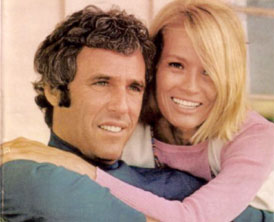
I vividly remember the first time I heard Dionne Warwick singing Bacharach & David’s “Do You Know the Way To San Jose.” Oh, enchantment! My little tyke self instinctively understood what was spelled out in those rhythms, that glide, that smooth. I conjured images of cars gliding down LA freeways, a butterscotch lollipop against an azure sky, gas stations where stars pumped gas with white plastic sunglasses pushed atop blonde hair glowing in the sun…
I bought into the California way of life without even knowing they were selling.
At that tender age, I also bought into the entire catalog of the Bacharach way of life. I knew nothing of lifestyle choices of the modern era, of suburban cocktail parties in green and aqua rumpus rooms. I understood nothing of Bacharach’s musical blending of jazz, classical, pop and rock, or Hal David’s seemingly light yet incisive lyrics, the two men a modern-day George & Ira Gershwin. I hadn’t even equated that all the songs that stirred the very core of my tiny tot being came from the same men, or that their vision was perfectly expressed through the voice of one or two women.
I only knew that certain songs transformed the very moment within which I heard them. I could be absorbed in a coloring book when suddenly:
…bohm, bohm, bohm, bohm (kick and snare)
“Oh, L.A. is a great big freeway
Put a hundred down and buy a car”
I was transported into a new world of die-cast precision scenes that came not from any personal experience, but from tuning into the frequency created by Bacharach & David. Their wave-length could physically spin me like a top as horns and strings pounded madly at the end of “Promises, Promises” or skip me lazily through a gentle downpour of “Raindrops Keep Falling’ On My Head.” A sorrowful, insistent piano riff stopped my breath as a bank of ladies in sequined gowns chanted “Don’t stop/ Don’t stop” as a Garland-esque glamour girl wobbled past wailing:
“So walk on by
Make believe you never see the tears I cry.”
From Bacharach & David, I developed distinct notions that kissing boys gave one pneumonia, that the Lord would give us no more meadows until we got more of the love we needed, and that a lad named Alfie had all the answers but refused to spill the beans.
I was perfectly content with this world view.
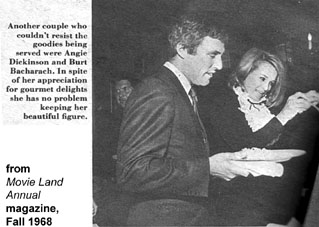
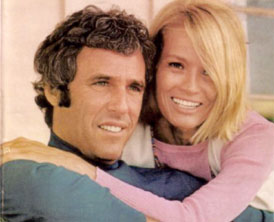
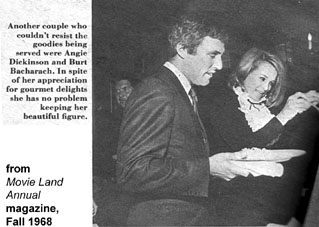
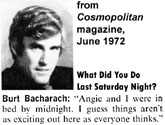
A little time passes, a grade-schooler distracted from homework by a TV commercial… Burt Bacharach at the piano with Angie Dickinson practically in his lap, frisky from both the vermouth and how utterly amazing they are. From that moment on, my ideal of love was based on the rosy glow surrounding Burt & Angie as they billed and cooed:
“Martini & Rossi on the rocks
Say yessss.”
Rather than sitting in our tiny little apartment in my polyester PJs, I wanted to be on the set with Burt & Angie, sitting on the hearth of that roaring fire, humming to the vibration that perfect love emits. My parents had just divorced, but Burt & Angie were together, perfect and gorgeous, the look of love was in their eyes.
I wasn’t yet sure what sex was, but I knew that “sexy” was Burt & Angie lounging by their Beverly Hills pool. I wanted a house near theirs, so they’d be my neighbors and come hang by my pool. In the afternoon sun, a massive stone BBQ pit smokes while a purring blender makes us frothy pink drinks with aqua paper umbrellas jutting out of the foamy crest. We all laugh as Burt tosses the tiny umbrella into my deep end…
”Together forever
That’s how it must be
To live without you
Would only be heartbreak for me.”
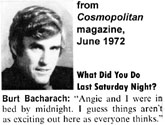
Being a musical genius married to a TV policewoman eventually spelled disaster for Burt & Angie, because by late 1978 they were separated and divorced by 1980. One can’t help but notice that Bacharach’s 15+ years musical winning streak also came to an end around this time. The spell had been broken and I lost my symbol of Ideal Love at that very moment when Kid Crushes grew into Going Out, a cut-rate Angie auditioning a row of Bacharach-less.
To my mind and soul, any Bacharach & David tune equals the sound of love. Unrequited or passionate, serious or casual, brand new or faded, they have a song for and about it. For every Burt there is an Angie, and then there isn’t…
“and so for at least
Until tomorrow
I’ll never fall in love again.”
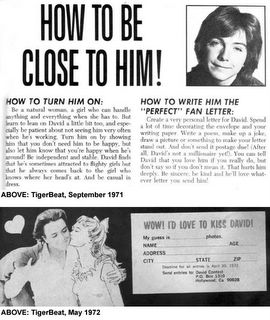 A magazine rack is like my Encyclopedia Britannica. It stems from being deposited in front of them at grocery stores while my mother did her kid-free shopping, and I’ve gleaned, easily, 50% 0�f my knowledge from this life-long habit. I also use magazines as comfort food; if I’m feeling blue, I’ll cruise through an issue of MAD magazine. A recent magazine expedition unearthed the ultimate comfort food, my macaroni and fish sticks, TIGER BEAT!!
I was shocked that it still existed, figuring it bit the dust around the same time as 16 Magazine. What’s even more shocking is that it’s still published by Laufer (1970s: The Laufer Company. 2000s: Laufer Media Inc.). Did I hold in my hand a nearly-unchanged concept, the key to a brief return to a more innocent time? I gladly paid $4 for a thrilling return to yesteryear (though I went to self-checkout, what with me being an adult buying a teen magazine and the whole Michael Jackson trial thing).
Did I overly romanticize the Tiger Beat return? Certainly.
It’s a whole new generation of pre-teen Prosti-Tots, and magazines wanting their abundant allowance money have to keep pace. On first read-through, the difference between today and yesterday issues is much like Victrola vs. iPod.
DIFFERENCES
The only punctuation mark used in the Old TB was the exclamation point. In these more somber times, the New TB uses them sparingly.
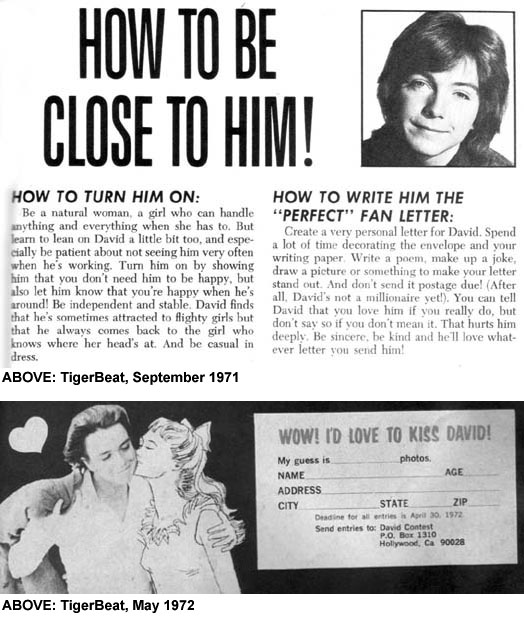
Old TB strived to help you connect with your favorite, with details on where to find him, how to dress and act to get his attention. New TB has put the kibosh on such tips due to stalking, celebrity murders and illegal underage sex issues.
Vital statistics (including neck, in-seam and shoe sizes) and questionnaires (What’s Your Favorite Cereal?) with handwritten answers were the backbone of the Old TB. The New TB would court lawsuits with questions like “What habit would you like to break?” and thus avoid it completely.
Old TB had few paid advertisements proper, and all other ads were for items directly related to the stars within (posters, paperbacks, pillows, fan clubs, etc.). New TB has just a few more paid advertisements, but obviously gets revenue from copious product placement within stories, a la In Style magazine.
Old TB offered endless contests that let the winner meet her favorite (“Fly To Hollywood & Kiss David Cassidy!”). New TB? See “illegal underage sex issues.” Now contains lots of “quiz-o-ramas,” personality tests and Jesse McCartney palm readings.
2 to 3 pages worth of wordy articles on the most popular favorites filled out every issue of Old TB. The New TB follows the short-attention-span format of lots of pictures with extended cutlines. Articles consist of very large pictures and up to 5 paragraphs of text.
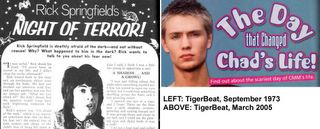
SIMILARITIES
Tragedy befalling our hero remains a pre-teen staple.
Be it Susan Dey or Hillary Duff, all past and present female teen stars hate something about their physical appearance, yet persevere.
No matter the decade, teen stars with no musical background or talent continue to make records.
No matter the decade, all faves are assigned elaborate and poetic quotes that never once sprung from their lips.
Generic snail mail addresses are listed, and as always, the letters go directly into the dumpster behind the building it was sent to.
2-sided centerfold posters, pin-ups and a plethora of photos.
And posters would be the only reason these types of magazines still exist in today’s instant-access world. All major teen stars have elaborate web sites. DSL and satellite beams in any song, show or movie they want at the time they want it. But the typical 8 year old’s need for a large quantity of Ryan Cabrera photos on her bedroom wall cannot be met by Dad’s $75 HP printer. Tiger Beat, J-14, Bop, etc. are still the only way to create the perfect photo collage on your closet door.
The teen magazine publishers and editors know this, and thus, have let the rest of the content fall to sub-tabloid levels. Not to say that “Bobby Sherman – The Loneliest Day of His Life” was worthy of The New Yorker, but it was a lengthy, meaty article, giving a girl something to contemplate. Today, teen magazines provide only G-rated, watered-down rehashes of what Star and The National Enquirer reported 2 months ago. And what other choice do they have? When your media-savvy 7 year old discusses Tara Reid’s terrifying nip slip with her friends, J-14 is really not out of line printing a safe version of such. Child-like innocence is such an antiquated concept that thumbing through the old teen magazines is now akin to reading ancient fairy tales. It was once easy to keep the sordid reality of Leif Garrett and Andy Gibb off the pages of SuperTeen. But when your kids already know about Mary-Kate Olsen and Lindsay Lohan’s barely-disguised substance abuse, should teeny-bop editors blatantly ignore that information for the sake of childhood innocence? No, because they are money-making publishers, not parents. The current teen magazine industry can rest easy in knowing it has no power to set trends, only follow them.
Though, there is one grand tradition still in play, and perfected, for the 21st Century. The trick of the completely fabricated personality and talent that was once the exclusive rights of the rarified world of teen magazines is now a profitable multi-media concept.
Yesterday: Only after Leif Garrett had cemented his grassroots appeal did he earn the right to make records full of massive pitch control and compression. He was a real boy whose natural charisma allowed him to live a lie. Today: Ashlee Simpson is a lie that bought the right for the media to manufacture some charisma for her. Yep, seems even the creation of a falsehood was more organic in the old days.