Showing posts with label blondie. Show all posts

February 04, 2012

Teenage Scribbles: Debbie Harry


Debbie Harry of Blondie, June 16, 1979
Color pencil on 3-hole punch paper


For every serious music fan, there is that one song, that one moment that completely changes their life. It’s such a dramatic, cinematic scene, that in regards to that event, to classify one’s life as B.C. or A.D. is the only way to convey the religious weight of it.

My personal Jesus appeared before me the first time I heard Debbie Harry sing, “Yeah, riding high on love’s true blueish light/Ew ew oh oh.”

At the time, I was a Casey Kasem Top 40 junkie. From the first moment I heard “Heart of Glass” the very first week it hit the Top 40 chart, my antennae started quivering. I knew the song was trying to be disco but it certainly wasn’t; there was a lot more going on under the covers. And I suddenly remembered all the little bits about Blondie that I’d run across previously in magazines, and I could literally feel pieces falling into place.


Debbie Harry, September 16, 1979
Color pencil on letter bond


I rushed out and bought the single, and actually liked the flip side ten times more. “11:59” was urgent and pleading while the singer’s voice was cool and detached and the dichotomy sucked me under. Plus, the label said “Produced by Mike Chapman.” Oh, man, count me in!

I then rushed out to buy the album, Parallel Lines, and there was no going back. Despite the prejudice of my religious conversion, the cover to that album is still one of the most striking examples of album artwork, simple yet effective, able to convey layers of meaning and style with just a few broad strokes.


Deborah Harry, November 18, 1979
Color pencil on ledger paper


That album sounded like a jukebox full of promise, sounds that I’d heard in various forms before, but were now brought together under one umbrella. I heard “Sunday Girl,” and “Pretty Baby” and thought them just as yummy and hook-filled as any of my childhood AM pop favorites, and they did a cover of a Buddy Holly tune! But I also heard hard, chaotic, frantic sounds that riled me up, like “One Way Or Another,” “Hanging On the Telephone” and “Will Anything Happen?” and I asked myself, “Is this punk rock?” Plus there was a slow, eerie tune with this dead and hollow drum beat (“Fade Away & Radiate”), a song that mentioned watching someone shower, and the very last song on the album telling someone to piss up a rope. “Heart Of Glass” was the lamest thing on the album, and I was ecstatic!

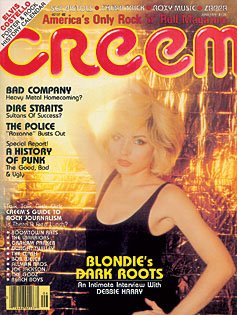
I tapped my alien powers of information gathering for a crash course on Blondie. I found new magazines like Circus and Hit Parader, but it was blast to find Blondie popping up in staples such as People, US and Dynamite. I very quickly learned as much of the Blondie M.O. as possible, had a broad overview of what they were about, what they represented and how they were popular all over the world save for America, where they were deemed too odd, too different, too “punk.” When “Heart Of Glass” hit #1, I was as shocked as I was pleased.


Deborah Harry, March 23, 1980
Color pencil on 3-hole punch paper


Blondie were a new and different world of music, a stranger, more varied world, where not all songs were love songs, where there was subtext and layers of meaning behind every lyric, every riff, and every artistic decision. Blondie was the tree trunk that sent me out onto a thousand branches, where I finally learned about punk (checked out dozens of albums from the library; the Sex Pistols’ debut album didn’t sound like Blondie, so I didn’t care for it, but the Ramones were intriguing), Andy Warhol, CBGB’s, underground art and films, early 60s girl group pop, and that there was a lively, exotic world thriving outside the Billboard Top 40. I learned more about the world of culture within a couple months than I had in my previous 13.5 years. It was heady and addictive.

“Blondie is a group,” and then there was Debbie Harry. Say it again, my bruthas and sistahs: Debbie Harry! Amen.


Deborah Harry, May 1980
Water color on bond paper


She was (and is) a goddess! Aside from Cher, I’d never experienced anyone like her. She was absolutely gorgeous, cooler than shit and had the most glamorous clothes, shoes and hair imaginable. In print, she was intelligent and insightful, but very coy about her past, her private life and her age, which gave her an air of mystery. She and her boyfriend, Chris Stein, created and ran the band, and she was an equal partner in songwriting, presentation and direction. Again, I repeat, I’d never experienced anyone like her; she was so beautiful and powerful and talented that she seemed more like a comic book hero.

Everything I needed to know about life, sex, fashion and music, I looked to Debbie. And because American media was now as infatuated with her as I was, it was easy to get all the advice I needed.


Blondie Was a Group, January 1983
Charcoal on sketch paper


Blondie profoundly altered my viewpoint of the world, and I had the utopian belief that it affected everyone else, too. I’m sure it did in many quarters across the nation, but at Kirby Junior High in north St. Louis County, there was no change at all. When I dared speak to someone else about Blondie, it was a bad topic. If someone wasn’t talking trash about them being a disco band, they were thinking they were too punk, too fucking strange, uncool.

But I knew they were all dead wrong, and the “Us & Them” mind set took firm root in my psyche. I’d unwittingly found a way to further ostracize myself from the peer group, but this time it left me with a whole other – and better – world to explore, football fields of things to think about, which made ignoring everyone so much easier to do. 


D.H. a.k.a. B, April 1983
Charcoal on bond paper


June 19, 2006

Def Leppard

Yeah! is the most appropriate album title since Never Mind the Bollocks Here’s the Sex Pistols. While the Pistols’ made a declarative statement, Def Leppard simply went with the gut response one gets at some point during each of their cover choices.

It feels both weird and titillating to be energized in the summer of 2006 by a band that had some of my attention for a few years in the early 1980s. Along with New Wave, I bought into the New Wave of British Heavy Metal, and bought Def Leppard’s 1980 debut album,
On Through The Night. I hated the cover art, and was left cold by most of the contents, but it was obvious from interviews that Joe Elliot was a huge glam rock fanatic who was jazzed to finally have a band of his own, and they were all awfully young and cute. At 15 years old, this was sufficient reason to be a fan.

But the follow-up,
High ‘n’ Dry, was a genuine blast, and when unloading all my Def Leppard vinyl years ago, it’s the only one I held onto because it still moves me, hard. The band still had all the original members, and Robert John “Mutt” Lange came on board to create a loose, power crunch of pop metal. The singles “Let it Go” & “Bringin’ On The Heartbreak/Switch 625” still work perfectly.

There’s also a sentimental attachment to High ‘n’ Dry-era Lep. The weekend I turned 16 years old was celebrated with concerts by Van Halen (the Fair Warning tour), and Def Leppard. Actually, DL opened for Blackfoot (who?!), and even at that time, it was an absurd and backwards bill. But the DL boys packed a lot of tight rock into a 40-minute set, and they were awfully hot. When overly inebriated on a Sweet 16 weekend, that – and David Lee Roth the next night – was all I needed.

In 1983, there was no ignoring
Pyromania. Coming out the radio, “Photograph” was a bright and immediate latch-on. Then MTV bombarded our every viewing moment with the video (actually, it was more of a sword fight between DL & Duran Duran’s “Rio”), and chart domination was complete.

The appeal of that album was undeniable, but the relationship between Def Lep & Lange intrigued me way more than the music. Much like George Martin with The Beatles, or Roy Thomas Baker with Queen, producer and band worked together on the tunes to craft a distinct sound. In the process, these bands became better musicians, and left behind instantly recognizable slices of rock.

Robert John “Mutt” Lange produced a lot of seminal hard rock albums, but Def Leppard were like putty in his hands, allowing him to craft a signature wall of sound that eventually sucked the blood out of DL. While I wasn’t a fan of the chipmunk compressed vocals and layers of frills Lange plastered onto the boys, I did appreciate an audio craftsman perfecting his vision. Lange moving onto his own sonic Barbie Doll with Shania Twain makes perfect sense, and bought him a large chunk of New Zealand. So bully for Lange, but too bad about Def Leppard (if you consider untold riches and popularity a detriment to creativity), who were left without a master.

After floundering about, the boys decided to take a breather and rediscover what inspired them in the first place. What they discovered was pure joy, and how to properly share it.

Yeah! is absolutely exhilarating, both musically and spiritually. By returning to their roots, they uncovered the band they actually were under all that Lange pop rock tulle. They gave themselves a parameter: only 1970s British (save for Blondie) bands they loved before they got signed. They used a democratic system for song selections: everyone made a list and they found the common threads. They used good judgment: no obvious choices. They used their smarts: what they’ve learned over the decades reapplied to what made them do it in the first place. And they produced it themselves so they could just revel in the moment and deliver an honest set of songs.

The songs they settled on got my attention just from the advance blurbs. Anyone combining T. Rex, Blondie, Sweet, Kinks, ELO, Mott The Hoople, Badfinger, Roxy Music and Thin Lizzy on one record will probably get my cash. I did cringe at the thought of Def Leppard going light alloy on “Waterloo Sunset,” but that hurdle was easily cleared.

A good song is a good song, and shouldn’t depend solely on the performance. Ray Davies made an eternal impression with his wistful, trembling “Waterloo,” and anyone who’s covered it since latches onto that melancholy. Def Leppard get major props for having the balls to give the song some meat, and Joe Elliot’s vocal interpretation changes it from a hermit’s view of life, to an observer weary of city life just looking for humanity where it hides. In the extensive liner notes (totally worth the price of admission), Elliott writes: “
I don’t know what it is about the Kinks, but they had a wonderful knack of making what were essentially sad melancholic songs sound so uplifting! … his chord structures were so simple, that had they been kids, they’d have been in remedial class! Brilliant.”

Elliott’s brilliance is in understanding that, seeing it as a template, and knowing more could be pulled from this classic tune. And for every time Joe endears himself to me with his reasons for doing a song (
“We had, HAD to pay tribute to Roy Wood somehow – so how???"), he and the band then deliver more than expected (ELO’s “10538 Overture,”) and more than we may deserve.

Twice, DL has me loving their cover more than the original: David Bowie’s “Drive-In Saturday” & Mott The Hoople’s “The Golden Age of Rock ‘n’ Roll.” That last one made me feel like a traitor, but when considering how much Elliott adores Mott, he thought long and hard about how to do this without embarrassing themselves.

He shares his theory that the song “was really a Sex Pistols song minus, er, the Sex Pistols guitars!!! …it’s big, ballsy, & if I’m honest, the one song I had doubts about singing!! Paul Rodgers, no problem (they also cover a Free song); Ian Hunter, he’s my hero!!! What if I ballsed it up?!! …If I’m honest, I thought it was about time you all heard where the “woah ho” stuff in “Photograph” and “Foolin”’ and a lot of our “call to arms” choruses really came from.” And then they got Ian Hunter to appear on the song! You can just hear Def Leppard popping a woody every time they think about that.

The band introduced me to something I’d never heard before, but now can’t live without: “He’s Gonna Step On You Again” by John Kongos, a British one-hit wonder. And they tried a noble experiment that most everyone but me loves: “Rock On” by David Essex.

They’ve made me swoon because each band member picked a favorite album cover to replicate (Phil Collen doing
Raw Power = hot), and if he could curb his exclamation point tendency, I could read a novels-worth of Elliott’s music musings. Plus, I discovered some things undetectable under all that Lange production: Joe Elliot has an elastic, authoritative and manly voice, and Def Leppard just plain rocks; no disclaimers or descriptors, just rocks.

So, this is a kick ass summer album, and I’m grateful for every second. But what next?

Considering how the band has opened up and gone back to basics, this should translate over to future original work. Because, how can you have a journey like
Yeah! and remain unchanged? They’re 27 years into this game, and should have the guts to do as they wish from here on out. I’m hoping that they remain so jazzed by reconnecting with the essence of rock fanaticism that it allows them to drop the gimmicks and marketplace facades and produce something worthy.

Joe Elliott on their cover of “Hell Raiser”:
“The Sweet were, in my opinion, wrongly accused of being puppets because of their involvement with Chin & Chapman – an accusation occasionally leveled at us when we worked with Mutt Lange. All nonsense, of course, for both bands!!”
Here’s hoping that, in the future, Def Leppard remembers what they’ve learned from their past.

RELATED
Blondie
T. Rex & Sweet

April 16, 2006

Blondie

Much like calculus, yard work or NASCAR, the Rock & Roll Hall of Fame is unimportant to me, so I only just now got around to watching Blondie being inducted into it. Blondie being “honored” in such way was a big yawn… until I was genuinely moved by parts of Shirley Manson’s introduction speech:

“Blondie will enter the hall of fame as one of the coolest, most glamorous, most stylish bands in the history of rock & roll… There is just coolness and sweetness and integrity and grace.

“Debbie Harry, the most beautiful girl in any room in any city on any planet… She carefully subverted her mind-blowing beauty with her punk spirit and her gladiator heart.”

Chris Stein put it best when he responded with, “That really put dents in my cynicism.” Agreed. It also caused a flood of old feelings to break my dam.

For every serious music fan, there is that one song, that one moment, or that one album that completely changes their life. It’s such a dramatic, cinematic moment that classifying ones life as B.C. or A.D. is the only way to convey the religious weight of it. My Jesus of Cool rose from the dead the moment I heard Debbie Harry sing, “Yeah, riding high on love’s true blueish light/Ew ew oh oh.”

I heard “Heart Of Glass the very first week it hit the Top 40 Billboard chart, and my antennae started quivering. I knew the song was trying to be disco, but there was a lot more going on under the covers. I suddenly recalled all the little tid-bits about Blondie that I’d run across in my teen girl magazines (like a picture of Debbie with Brooke Shields), and I could literally feel pieces falling into place.

I bought the single, and actually liked the flip side
much better. “11:59” was urgent and pleading while the singer’s voice was cool and detached, and the dichotomy sucked me in. Plus, the label read:
"Produced by Mike Chapman.”
Oh, man, count me in!

I then rushed out to buy
Parallel Lines, and there was no going back. Despite the prejudice of my religious conversion, that cover is still one of the most striking examples of album artwork: simple yet effective, conveying layers of meaning and style with just a few broad strokes.

That album sounded like a jukebox full of promise. Sounds that I’d loved in various forms before were now brought together under one umbrella. I heard “Sunday Girl,” and “Pretty Baby” and found them just as yummy and hook-filled as any of my childhood AM pop favorites, and they did a cover of a Buddy Holly tune! But I also heard hard, chaotic, frantic sounds that riled me up, like “One Way Or Another,” “Hanging On the Telephone” and “Will Anything Happen?” I asked myself, “Is this punk rock?”
“Heart Of Glass” was the lamest thing on the album, and I was ecstatic!

With a gift of hyper information absorption, I went through a crash course on Blondie. I discovered new magazines like
Circus and Hit Parader, and it was blast to find Blondie popping up in staples such as People, US and Dynamite. In short order, I was a Blondie encyclopedia, and when “Heart Of Glass” hit #1 two months later, I was both shocked and pleased.

Blondie was a new world, where not all songs were love songs, where there was subtext and layers of meaning behind every lyric, every riff, and every artistic decision. Blondie was the tree trunk that sent me climbing onto a thousand branches. They “schooled” me on punk, Andy Warhol, CBGB’s, underground art and films, early 60s girl group pop, and that there was a lively, exotic world thriving outside the Billboard Top 40. Blondie taught me more about the broader cultural world within a couple months’ time than I had learned in my previous 13.5 years. It was heady and addictive.

“Blondie is a Group,” and then there was Debbie Harry. She was (and is) a goddess! Aside from Cher, I’d never experienced anyone like her. She was absolutely gorgeous, cooler than shit and had the most glamorous clothes, shoes and hair imaginable. In print, she was intelligent and insightful, but very coy about her past (back then, she had age issues), which gave her an air of mystery. She and boyfriend Chris Stein created and ran the band, and she was an equal partner in songwriting, presentation and direction. She was so beautiful and powerful and talented that she seemed more like a comic book hero than a real-life woman, but it was all true. Everything I needed to know about life, sex, fashion and music was learned at Miss Harry’s feet, and because American media became as infatuated with her as I was, it was easy to get all the advice I needed.

Blondie profoundly altered my view of the world, and I had the utopian belief that it affected everyone else, as well. But I quickly learned that at Kirby Junior High in St. Louis County, there was no change at all. Blondie was a bad topic with my peer group who labeled them disco, or punk, or queer or strange. I knew they were dead wrong, and the Us vs. Them mind set took firm root in my psyche. I’d unwittingly found another way to further ostracize myself from my peers, but this time it left me with something better. Blondie gave me football fields of things to think about, which made staying quiet and ignoring everyone so much easier to do.

Blondie was always ahead of the curve on so many fronts, and because of this gift (or curse), they sometimes confused me, but they always wound up accurately predicting future pop trends (for better of for worse). After Blondie melted down, Debbie Harry continued to improve as an artist. In her 50s, she took on the exacting task of becoming a jazz singer, and her time with the Jazz Passengers turned what was previously a distinctive and effective voice into a true musical instrument that has vastly enriched the sound of the present-era Blondie. Most singers’ voices erode with time; hers improved. That is just one example of the alien miracle that is Deborah.

And it can’t be stated enough: She’s just naturally cool, “with her punk spirit and her gladiator heart.” Even when an ex-band mate tried to put her on the spot at the induction ceremony (read Chris Stein’s tale of the event), she breezed right past it with a crack and a kiss on the lips. To be so continuously and effortlessly cool for so many decades is, basically, impossible. That may sound so junior high of me, but so what? If someone thinks “cool” isn’t important, than they never truly got rock at all…and they probably think the Rock & Roll Hall of Fame is important. It’s not, but Blondie is.