March 29, 2009

Sexual Archetypes: the 30th Anniversary of "Sooner or Later"

We all react to subconscious triggers embedded in our brains, and often the key to breaking a habit is making the effort to unlock that code. Sometimes it's impossible to identify Ground Zero, while other times we know exactly what it is and the struggle is to try and lessen the power it has over you.

There is a certain type of guy that always sets off my alarm. While I don't consider this a bad habit, it does tend to make me overlook a more appropriate type of mate simply because he doesn't match the archetype. This was never considered a problem when I was younger, but now that I'm on the other side of 40, I wonder if remaining keenly attracted to this specific archetype will eventually back me into a corner? Should I try to break this spell? Can I? And do I want to?

I know my Boy Ground Zero: It was March 25, 1979 when ABC aired Sooner or Later, starring Denise Miller (fresh off the TV series Fish) and Rex Smith. If you don't know the story, within this page, I've depicted the most crucial plot points of the story, as remembered from the perspective of a 13-year old girl. That's exactly how old I was when it aired, that's how old the character Jessie was in the movie, and that was the target audience.

The film was written, produced and directed by Carole and Bruce Hart, who did a masterful job of knowing exactly what things 13 year old girls obsessed about. Horrible job yes, but if you've got a job to do you gotta do it well. There are plenty of money guns aimed at that demographic at any given moment, but it takes a little more effort and heart to create something that goes off like a bomb at the time and then continues to resonate for years after.

On a Friday, not a single junior high girl knew who Rex Smith was, but come the following Monday, it was a wonder we'd survived that long without him. I was blown away because his singing voice sounded quite a bit like David Cassidy (my first true love), and unlike the fawn-like Shaun Cassidy (who was on my walls at this time - as well as on the walls of a character in the movie), Rex was a dangerous, sexy MAN. And he fell for someone my age!

Denise Miller was the perfect blank page for writing yourself into the story. She was cute, but not exceptional, so not a threat. She was audacious without being precocious, so a believable role model for a confusing period of life. She confirmed the secret to jump starting a love life - makeup. And she landed the hottest rock guy in a not too improbable way. It was the most believable of scenarios, and that air of real life possibility is probably what makes it an emotionally enduring film.

I bought the paperback book. I bought the album. I bought the issue of Us magazine with a feature on Rex Smith that featured a photo of him by a pool, completely naked save for an electric guitar. I swear to you the tip of his penis was visible in the picture. I threw Shaun Cassidy under the bus. I got a $35 acoustic guitar from Sears. I waited expectantly for my Michael Skye.

About 14 years later, I finally got around to proper guitar lessons. I about plotzed when my teacher was a long-haired, Italian stallion metal guy. Knee-to-knee in a tiny room, I could barely concentrate as he put my new Telecaster through its paces. I soon dropped the lessons because he was too hot for me to be serious about learning, and because it made all those latent Sooner Or Later emotions well up. That, and I also had a boyfriend who played guitar and had hair much like Michael Skye.

So, I went home and put the dog-eared paperback and the well-worn vinyl into a box of stuff that went off to a garage sale. This was the grunge era, so these items from a bygone era were way uncool and embarrassing.

Sooner or Later happened right after my puberty kickoff. The whole point of the movie was dealing with the issues of girlish daydreams becoming all too real. "They tell me I should slow up/ Take my time and grow up/ But sooner or later is too late."

It quickly becomes apparent that the dividing line between child and teenager is hormones, and what to do about it. Your body tells you plenty, you're all ears, but you don't understand and are mortified by what it's saying. The outcome - sex - is inevitable, but it's the steps toward it that were the most confusing. Wait, that aspect doesn't change much, no matter how old you are. I guess we just have so much practice with it that it's no longer as scary.

But it was that fear of the unknown that made it so indelible and so special. Just like first love, the lead up to first sex is filled with rush of new emotions that then become unsustainable once you've experienced it. They are replaced with sensations that we experience over and over again, in many new and different ways, but The Firsts have a powerful hold on our psyche.

Many, many years later, my Mother ran across Sooner Or Later on cable, and was kind enough to tape it for me. I circled that tape for a few days, afraid to watch it again 20 years later because what if it sucked? I loved those memories from that time; why chance ruining it?

Have you ever run across an old commercial from your childhood that you completely forgot until you saw it again, but it was like being transported right back to that very moment in time, and you recall it all crystal clear? The sensory input actually produces a physical reaction; it can make you feel good, instantly. I believe the physical sensation it produces is why we spend so much time on YouTube - it's like huffing emotional glue.

My second viewing of Sooner Or Later was the second coming of puberty, and it was good. Real good. It turned out to be an exceptionally well-written and executed piece of work with an honest, emotional core that allows it to float past being unduly dated by its time period. Yeah, all that... and it had me giggling and screeching like a 13 year old girl, all over again!

I swooned and cringed in the exact same spots as before. Every emotion was just as pure and expansive as it was at 13, and being able to fully conjure that at such a late date was a heady experience. It reminded me of a Rufus Wainwright song: "I twist like a corkscrew, the sweetness rising, I drink from the bottle, weeping why won't you last? Why can't you last?"

Well, yes, it can last - just hit rewind!

Viewing it from an adult perspective just adds to the fun. Considering my age, it's now PG cougar porn primo, and I appreciate the care they took in lingering on certain camera angles. It produces this weird sensation of my teen and adult selves swooning simultaneously for different - but just as valid - reasons. It's as close to an out of body experience as I'm going to get without meditation or medication.

During the drive-in scene, Michael sings "She's Still a Mystery To Me" to himself as Jessie stuffs her face with junk food to avoid the necking that accompanied drive-in dates. Jessie asks what's the song, and Michael teaches her about John Sebastian and the Lovin' Spoonful, following up with another pointed reference by singing "Young Girls." This makes Jessie cry, because she has a bucketful of secrets to soon reveal, but at the time, it sent me to the library to dig deeper into the Spoonful, beyond the radio hits. So, Rex, thanks for another enduring gift!

Jessie is 13, Michael is 17. Yes, technically, it will be statutory rape (if 17 was considered adult in Yonkers in 1979). That's the first lens we view through, today. But of far more emotional impact is the deep sea change within that 4 year age difference at that time of life. The writers didn't need to cite laws to make the revelation of the concealed age difference so gut-wrenching for both of them.

But it does beg the question: could this story be told as convincingly today? For multiple cultural reasons, a 13 year old girl is a much different creature than she was 30 years ago, outwardly. Could the changing shape of society, parenting and criminal paranoia make this a quaint, old-fashioned story?

I've now watched Sooner Or Later with male and female friends around my age, some seeing it again, some seeing it for the first time. Everyone enjoys it, which verifies that it truly is quality work. But I've yet to have a clock in from a young girl of today. Would the story resonate? Would the Michael Skye type still be considered foxy in this era?

Personally, the Michael Skye type still resonates within me. Maybe a bit too strong... depends on the perspective and the day. I didn't need to see the movie again to conjure that, only to verify the starting point. But now that I know what the trigger is, maybe it will be easier to quell the sensation and explore the world of Non-Michael Skye types. Especially when I can get my fix any time I want by popping in the DVD!

Turns out there is a part two and three to the story of Jessie and Michael. The Harts wrote two more books about it. Waiting Games takes place immediately after, with 14 year old Jessie deep in a sexual relationship with Michael, whom after declaring his undying love for her, leaves for Los Angeles to become a rock star.

Now or Never zooms ahead 4 years, finding Michael a drunken and failed rock star coming back home and hoping Jessie will take him back.

I haven't read the sequels, though I'd certainly love to. They are not available at any of the libraries, and the third book is fetching some crazy high prices in the eBay world, so that's not happening for me. I'm content with leaving it right where it is, and wishing we could get a little more 30th anniversary love for this romance classic.


March 13, 2008

THE LOOK OF LOVE: Burt Bacharach & Hal David at Hotel Murano

I have a long and intense history with the music of Burt Bacharach and Hal David. Burt & Angie Dickinson are still my illusionary romantic ideal. This has been covered in depth here, and this back story is what makes the following story so monumental. Oddly enough, the back story ends on the same note that becomes a climax of this story.

My friend Jim Staicoff had been talking of an amazing project he was working on in Tacoma, Washington, the Hotel Murano. When he came into St. Louis in December 2007, he told me that for the grand opening of the hotel on March 8, Burt Bacharach would be playing in its ballroom. He then casually mentioned that Hal David would make an appearance that night.

My head exploded.
In their 40-year history as a songwriting team, they had never appeared together on stage. Hal is 87 years old. How is this possible?! And if it happens, I must be there.

Jim said he would do all he could to get me into that show, which would take some doing, as it was a $500-a-plate charity event for the Tacoma Art Museum that was already sold out. The whole concept was so surreal that I had to let it go. But Jim worked miracles and found a way to, literally, sneak me into the event.

The Hotel Murano is absolutely fabulous. Read about that experience here. But as fabulous as it is, it can't top what happened in the ballroom.

That's me with Hal David, above.
Yeah, that's me with Hal David!! My inner voice repeats this constantly; it will become an annoying tick in my senility.

As we drove up from Portland, Oregon on the day of the show, Jim gets a call from his design partner, Denise Corso. Eunice told her that the Murano is the most beautiful American hotel she's ever been in.
"Who is Eunice?" I ask.
Eunice is Hal's wife. They checked into the 24th floor the day before.
Is it OK to be first name-only with a musical god? My head exploded.

Since Jim met Hal & Eunice earlier in the night, once we got into the ballroom, Jim dragged me (because I was petrified) over to the table for an introduction to Eunice & Hal. How I managed to speak while my soul was in orgasmic turmoil is still a mystery, but I somehow told him (in a hopefully coherent manner) exactly why this moment was so special for me, and for music history in general:

"Ira Gershwin never came to the gigs of his brother George. Bernie Taupin has never stepped on stage with Elton John. Lyricists just don't usually do such a thing. But you are an exceptional man of words, and this is an exceptional moment in time. I am deeply honored to meet you."

Hal David seemed happy to let me have a picture taken with him. For this photo, I touched greatness. He even touched me. I did not faint, but my disbelieving heart was breaking with happiness.

Then came the concert.
I have seen Burt Bacharach probably 8 or 9 times, starting when I was 9 years old, when he appeared at the St. Louis Muny Opera with Anthony Newly. I have seen him with Dionne Warwick and the St. Louis Symphony Orchestra, twice. Every occasion is special because, as Hal David wrote on his website, "Burt is a man of many talents - a masterful arranger, an outstanding conductor, but first and foremost a brilliant composer. Among songwriters there are many tune writers but just a handful of composers. He is one of the few."

Along with the selections one would expect - and never tire of - he and his band and 3 singers did "God Give Me Strength" from his collaboration with Elvis Costello and a selection from his 2005 politically-minded record At This Time.

What made this concert a tear-stained event was that Hal David was sitting at a table behind us (how did we get better placement than him?), and I could look at Burt and turn to look at the man who wrote the words. And get this: Hal was mouthing along with the words he wrote! I could never have even imagined such an event, much less this occurrence at the event. My head exploded.

Near the end of the show was the moment I couldn't fathom happening: From the stage, Burt announced Hal was in the audience and confirmed that it was the first-time ever that Hal would come up on stage and sing!

Hal David sang "I'll Never Fall in Love Again." I captured this mind-bendingly historic moment using the video setting on my camera, thus the quality is not the best (it's a bit shaky because I was a lot shaky), but it is captured.
Here is Part One.
Here is Part Two.

My head exploded.
And then Jim says we're heading up to the 25th floor for an invite-only reception for Burt & Hal.
No, I can't take anymore. I met Hal David, had my picture taken with him, watched Burt, watched Burt and Hal together... I had spent my limit of good fortune and was emotionally spent.

Yes, you're going, and he steers me to the elevator where we ride up with Eunice and Hal David!
My head exploded.

"Hanging out" in a room with Hal David was unsettling. Rather than liquor to calm my nerves, I go over to the banquette to pour a cup of coffee. At this point, Hal & Eunice are seated at tables behind me, and I can hear them having casual conversation with people they know.

During the show, Burt introduced "Arthur's Theme" as being written "with ex-wife Carole Bayer Sager" (because we were so close to the stage, I politely refrained from hissing at the mention of her name). I overhear a lady at the table say she didn't realize "Burt and Carole were divorced. When did that happen?"

Eunice answers that it was "long ago," (1992, to be precise). The lady asks what became of Carole, to which Eunice answers in a politely dismissive tone, "Oh, she's married to, oh, Bob... I can't recall his last name."

I'm overhearing casual conversation about Burt from the mouth of Hal's wife! That the pouring coffee didn't wind up all over the countertop while my head was exploding is a minor miracle. I slammed down the coffee, surreptitiously took the photo above and left because my head hurt from all the explosions.

I was barely back in the room when Jim calls: Get back here now. Burt's here!
Oh shit. Is there any head left to explode?

And here's Burt Bacharach. I adore that he left the stage, went back to his room, peeled off the suit and changed into clothes that looked Sunday morning casual when contrasted with the surrounding formal attire. Good for him.

And here is what one looks like when their head is exploding while standing near Burt Bacharach.

Here's where everything turned into a dual existence in lightening speed slow motion, of being detached from the body while overwhelmed from being in the moment.

Once again, Jim stepped in where Toby feared to tread. He took my camera, walked up to Burt (gasp) and said there was someone here who came all the way from St. Louis just to see this show, and then he introduced to me Burt. I truly don't remember what I said to him; maybe I just blubbered like a lunatic. But I did manage to ask him if I could have my photo taken with him and Hal David. He said "of course."

With the audacity borne of an out-of-body experience, I peered across the room to spot Mr. David, and called out, "Hal!" Hal looks at me (probably thinking, "Oh, that head trauma victim from the elevator"). I ask, "Can you come over here for a picture with me and Burt (me and Burt, how fucking rich!)?" And he comes over!

With Hal next to us, I swear to you it's true that Burt says this: "Let's have Toby (he remembered my fucking name?!) stand between us, since she came all the way from St. Louis to see us." Burt moves me into place between them (Burt's touching me!) and flashes start popping.

I could feel my hands on their necks (yikes!) and with my head pounding, I leaned my head onto Burt and whispered in his ear, "Thank you." I leaned my head onto Hal and whispered in his ear, "Thank you." And I can't recall anything else because, well, my head exploded for the final time.

Here's me looking like a hurricane victim dragged from the wreckage. It is, without a doubt, the worst photo ever taken of me, but screw that. Look at Burt and Hal! They are god like! Anyone who had a heart could look at me and know this is the look of love. A lifetime of musical devotion culminates in a final moment I never conceived of. And I floated out of the room, into the hall and into the waiting elevator.

And I'm sharing it with Eunice and Hal David!

By now, I was completely emotionally spent. I fell back in the corner with my hand on my heart and waved my hand at them in surrender. They smiled sweetly, and luckily had to go down only one floor to escape this shipwrecked fool.

I went back to the room and stood in perfect silence, staying right in the moment because it was so exquisite. I met Burt Bacharach & Hal David! I had my picture taken with them! I will be the most annoying person in the old folks home from constantly muttering this.

To have left this room to go back to the party would have been a series of diminishing returns (and Jim said Burt left shortly after I did), an anti-climactic trek back down Mount Olympus. So I crawled under the covers, turned off the lights and say a little prayer for you, Burt Bacharach and Hal David.
Thank you.

RELATED
Hotel Murano: A Sleepover Art Museum

September 23, 2007

Death and The Camera Eye

A piece about the grand opening of the Ellis Hotel in Atlanta introduced to me the 1946 Winecoff Hotel fire tragedy. This introduced me to the riveting photo shown above, and that it could be the last photo of this lady.

Who took the photo?

While contemplating that, the iconic image above instantly came to mind, another jump from a building, this one intentional. For decades, this photo has conjured deep emotions, even inspiring a book and a song. In this instance, the photographer is known: Robert C. Wiles, but I can't find any information about him other than being credited for this shot.

Richard Drew took this photo on September 11, 2001, and it is known as The Falling Man. Debates about how inappropriate or necessary it was/is to see these images of people leaping from the World trade Center towers has continued for 6 years; how these photos make the viewer feel is the central theme.

Maybe because I'm a photographer, I relate to these images from the angle of the shooter, and always wonder how they deal with the lingering aftermath of their photo. It is understood that a photographer is instinctively reacting and recording when a dramatic moment happens; there's a pronounced disconnect between the person and their camera eye, capturing the moments on autopilot. Only later does the photographer truly fathom what was recorded.

As viewers of the photos, we can look and then look away. Certain images are burned into the mind's eye, and can be turned off and on at will. But the person who took these photos has an entire sequence to remember, or try to forget. For us, it's one or 2 frames; for them, it's a long playing memory. Yet seldom does the photographer get questioned about their thoughts and personal ramifications of being the one to freeze a flash point moment in time.

Richard Drew had captured the assassination of Robert Kennedy as well as the Trade Tower jumpers. This kind of repetitive odd timing gave him an odd notoriety and CNN talked with him shortly after 9/11. There's one thing he said at that time that reverberates hard because it may reveal the emotions felt by each of the photographers represented above:

"I don't think I captured this man's death; I think I captured part of his life."

June 06, 2007

A Farewell to The Price Is Right

Bob Barker filmed his last Price is Right, but there’s a time delay between his retirement and regularly scheduled programming. June 6th is a sad day, yet the big, bawling farewell is over a week away. It’s akin to pulling off the Band-Aid very, very slowly.

I think I’m goin’ back
To the things I learned so well
In my youth*

Making physical contact with the past can be curiously calming. Simply touching a childhood teddy bear or baseball glove can instantly transport us back to a free and happy place, a private moment of intense time travel. Anyone who has ever gone back to find their childhood homes or haunts either damaged or demolished knows the nauseous equilibrium shift that causes; it’s an erasure of everyone’s history. I feel that same kind of public sadness and discontent about The Price Is Right (TPIR) coming to an end.

It has been the only unchanging entity in my life from nursery school to this very day. TPIR is more than a game show, it’s a measure of time. It’s been like having a favorite grandma forever baking favorite cookies to take the edge off a hard day of adulthood.

Simply hearing the theme music creates a Pavlovian need for a fried egg sandwich, as my babysitter made me one to eat while hanging out with Bob Barker and Janice. Come grade school, I looked forward to the Shell Game and current Green Giant canned pea prices when home for sick, snow or holidays. Come high school summer vacations, the ending theme song meant it was time to stop sitting around getting high and actually go do something.

As a productive, organized and aspiring adult, any type of illness is treated with a medicinal viewing of TPIR. It’s my audio equivalent of, “Aw, you poor little thing. Here, this should make you feel better: A New Dishwasher!!!

Let everyone debate the true reality
I’d rather see the world the way it used to be*


We’ve all pretty much taken for granted that the show has never altered in any significant manner. Because of that, we may also not realize how bizarre the concept is: A daytime TV game show has aired for 35 years without ever really changing.

In our accelerating entertainment culture, TV shows are constantly being dickered with, and we accept new sets, new theme songs and new cast members as part of the deal. But aside from subtle redesigns of the Showcase Showdown podiums and Barker’s hair and weight, it has looked the same for 4 decades. Meaning, every M-F, there are millions of people between the ages of 3 and 93 watching repetitive actions take place on post-psychedelic department store décor from 1972, and it feels perfectly natural.


Surely at many points, some up-and-coming CBS hotshot suit has begged for a cosmetic update to appeal to (insert that season’s hottest demographic). Yet, it defiantly remains the same. Reporter Ken Smith wrote a nice piece about his day as a contestant hopeful in the audience. This part filled my heart with love:

“The first thing I noticed is how vintage the set looks, with its old-school light bulbs and glitter paint. I could clearly see the silver paint peeling off the giant “$1000000” sign they hang during the ‘Million Dollar Spectacular’ episodes, and the place even had a certain musty, old theater smell to it. While it’s comforting to know that the show hasn’t changed much in 35 years, I wasn’t expecting it to appear quite so lived in.”

Oh, that’s exactly how I imagined the set to be! It breaks my heart to be told it’s all really true because I lay you odds Barker’s town car had barely left the parking lot for the final time when producers started trashing the parts of the Styrofoam Fruity Pebbles set that weren’t stolen as souvenirs. Woe onto those impatient dismantlers, for the karmic wheel can become the Showcase money wheel always landing zero, and thanks for playing.


In a world of volatile programming, TV formats are constantly being altered for ratings. TPIR has danced with fellow game shows and soap operas, ignored Jerry Springer nation, waited out Oprah and judge shows, and remained standing as the only daytime game show. Week after week, decade after decade, the show goes on as if nothing has really changed, or changing just enough to avoid creepiness.

I’m confident that this fly-in-amber oddity is due to the resolve and power of Bob Barker. Obviously, the game show has always made piles of money for the network, so much so that it’s not worth a CBS CEO’s life to spar with Barker and his winning formula – his cleverly low-overhead formula. In the process of defining and defending his lucrative territory, Barker created a kingdom, and much like Henry the 8th, King Barker had many Queens.

But thinking young
And growing older
Is no sin*


One of the things that endear Barker to us is his good-natured irascibility. He came up when many game show hosts were sarcastic, flip and snickering, but Bob never converted to rice pudding to keep viewers. It’s this consistent personality trait that has me totally believing every story of affairs, pinching and parties that went on backstage between him and the Barker’s Beauties.


A few of his Beauties filed suit against him, and those were taken care of with a minimum of fuss and/or enough money to make them drop suit. He never denied what was true, but also never called a press conference to discuss it; his generation still follows a chivalrous code toward women. With chivalry in mind, I think it’s worthwhile to look at the Beauties from another reality.

Unlike being a Playboy Playmate, there are only about two handfuls of Barkers Beauties. This prestigious club has so few members that they couldn’t fill a short bus. It is also the only modeling gig with any measure of job security, because Barker is attentive to his ladies long past the industry’s typical sell-by date.

Janice Pennington, one of the original Barkers Beauties, is a brilliant example of rising above a “this year’s model” mentality. She was a 30-year old former Playmate when the show began in 1972, and reigned supreme until her dismissal in 2000, at the age of 58. That dismissal was not because of age – if that were really an issue she would have been gone a decade or so earlier – but because the Queen was disloyal to the King. Janice sided with the banished Holly in a court case. Previous to Holly’s dismissal (and subsequent legal battle with Bob) she worked with them for 18 years. I’ve never held one job for that long, have you?

Relatively speaking, TPIR must have been a great place to work, because no one ever wanted to leave. Show announcers only stopped working because of death (Johnny Olson and Rod Roddy), and death need not stop your billing on the show.

I can still hear Johnny say, “This has been a Mark Goodson/Bill Toddman Production.” Toddman died in 1979 but they kept using the production tag line until 1983. Goodson died in 1992, but “For the sake of tradition, and through special permission…The Price Is Right continues to use the Mark Goodson Productions name, logo, and announcement at the end of each episode, even though the original company no longer exists.”

“For the sake of tradition,” is the peculiar aspect of the shows longevity and success. In the malleable, superfluous world of entertainment, Barker was defiantly steadfast, upholding a tradition until we noticed it was a tradition. His unique business practices also created a sense of permanence, like families or the neighbors on the block where you grew up.

Now there's more to do
Than watch my sailboat glide

And everyday can be

My magic carpet ride*


So Barker’s retirement feels like losing my teddy bear just as the bulldozers come to demolish my childhood home. It’s a bit weird to feel so emotional over a game show, but The Price Is Right was a weird, magical adventure that transcended beyond several different realities.


Sure, the show will go on with a new host (who better not dare use the tall, skinny mike) and a new set with the prerequisite Battlestar Gallactica décor. There will be dry ice, silicone sister merchandise models, and contestants hamming it up in hopes of becoming the next celebutard. Considering the Barker Legacy, the producers had better not be fool enough to simply insert a new host into the 35-year old blueprint.

So catch me if you can
I’m goin’ back*


Bob Barker has certainly earned a rest, because 35 years of keeping an unwavering enterprise alive is hard work, even though he made it look easy. I hope our profound sadness does not ruin his triumphant farewell, and may he have a long and satisfying retirement. Thank you Mr. Barker, and help control the pet population. Have your pets spayed or neutered. Goodbye everybody.

* “Goin’ Back” by Gerry Goffin & Carole King

May 28, 2007

Farewell, Charles Nelson Reilly

As Bob Barker's retirement is just days away, I've been wallowing in nostalgic television research, which naturally brought Charles Nelson Reilly into the equation. I'm just a tad freaked that as I've been remembering how much laughter he brought me as a kid, he then ups and leaves this mortal coil. I have promptly ceased all thoughts of Brett Somers and Richard Dawson, hoping to avoid a Dies-In-Threes Match Game smack down.

From Horatio J. Hoodoo on Lidsville, to Match Game to Rowan & Martin's Laugh-In to my beloved Love American Style, Charles Nelson Reilly was like a 1970s prototype of Where's Waldo? He constantly popped up everywhere on TV, and it was always a treat when he did. Just like Paul Lynde, there was true humor for everyone of every age and awareness, and that's how it's supposed to work. A sad and fond farewell to a true entertainer.

April 15, 2007

Premiere Magazine: A Toast at the Wake

I’ve finished reading the final issue of Premiere magazine. Upon hearing it was laid to rest, my first reaction was, “Hey, I paid for a 2 year subscription!” My second – and lingering - reaction is sadness. The death of another magazine is disturbing on so many levels.

On a personal level, my mother’s movie magazines are some of my first memories (especially being spanked for scribbling in her stack of Photoplay). Upon learning how to read, magazines became babysitters. What has always been a sentimental, tactile and informational attachment could become an historical artifact rendering me a bewildered fossil.

On a fan level, after the sad and pointless content change of the once-genius Movieline magazine (it was to movies what Creem was to music), Premiere was the only American populace movie magazine left. Rather than concentrate solely on trivial aspects of celebrity, it was only about movies and the people who made them. I deeply appreciated this last serious holdout landing in the mailbox each month.

On an objective level, I’m one of those people whose “consumer behavior” has been radically altered by the internet’s easy and instant access to information. Yet, that subscription assured me at least one good meal a month amidst all the on-line celebrity junk food. So, I didn’t directly contribute to the magazine’s demise, but I do contribute to the culture that killed it.

Unlike Movieline, there’s a nobility in their decision to not cave in and follow the easy money that lowered standards can net. Their decision to be a web-only presence means they are still alive, and if Libby Gelman-Waxner can be persuaded to finally join them on-line (so far that column is absent), then I will make sure to regularly visit. But the stinging truth is that the internet has forever changed how we gather information and how long we wait to get it, and if Premiere wishes to be viable competition on those terms, then the cave in of previous standards is a prerequisite.

Paper vs. Plasma: What We Lose In Translation

This article from Daily Variety is an accurate telling of why Premiere had to die. One paragraph in particular brought understanding into sharp focus:

“In a universe where misinformation travels swiftly over the Web, Universal Pictures publicity executive Michael Moses would like to see studios enter the blogosphere and provide information directly to consumers.”

While the Internet basically killed my lifelong music magazine habit, the trade-off is bands being able to talk directly to listeners with much less music business hype and manipulation. Plus, the point is supposed to be the music itself, so jumping straight to hearing it means no more money wasted on records that didn’t live up to a dynamic review. So, if this sea change applies to selling music then, yes, it applies to selling movies, too.

With technological advancements, there is no going backwards (except during power outages), and I can no longer live satisfactorily without them (as proven during power outages). But the potential demise of the magazine saddens me because:

No More Layouts
Have you ever browsed an article you wouldn’t normally read because it looked so fabulous? Exceptional graphic design can lend substance to insubstantial content, and elevate the worthwhile to awesome. An art director gives atmosphere and impact to a magazine; as of yet, websites just can’t replicate or advance the art of graphic layout and design. Compare a feature layout in Entertainment Weekly to its web counterpart (above) to see the vast difference. I fear for the grand tradition of the visionary art director.

Diminished Photography
Have you ever spontaneously ripped a photo from a magazine because it was so arresting? Right-clicking, saving and sending a 72 dpi photo to your crappy printer just doesn’t cut it. Not that photographers need worry about job security in the face of magazine obsolescence, but it will become more difficult to see their work any larger than half your monitor size (on those websites that care enough to provide a larger pop-up version). Compare 9 x 12 inches to 100 x 200 pixels and understand the negative impact the web has on the art of photography.

The All-Important Cover
No matter the industry, “landing the cover” is the ultimate achievement. It is magazine covers that make the news, catch our eye in the grocery line and signal when someone has arrived. The coveted cover can be a classic Hollywood horror story, a graceful show of power, or a deal breaker when it’s denied. Websites just can’t do covers, and they need to develop some new form of prestige to take its place.

Bathrooms & Waiting Rooms
What will we read in those places? Do people actually use laptops while sitting on the pot? And if magazines disappeared, what would be left on our coffee tables for guests to browse through?

Frickin’ Ads Everywhere!
Most magazines adhere to a format of ads in the front and the back, with only a few placed between features. This keeps advertisements from gunking up the layouts and content in the heart of the publication. On-line, there is never an escape from ads, and this means there is never a truly attractive or contemplative webpage layout.

No Chance To Linger
The Internet delivers tons of information real fast, so I’ve developed the skill of speed skimming to take in as much as possible before my eyes spazz out. A magazine can be like the cool down after cardio kickboxing. A magazine is like savoring a good meal, while the Internet is like gobbling fries in the car. I need the balance of both options.

Two-Timing the Print & Cyber Entities

Rolling Stone, Vanity Fair and Entertainment Weekly are magazines with a concurrent and strong web presence. I subscribe to VF and EW, and have barely thumbed through an issue of RS in the 21st century.

Even though they continually promote it in the magazine, I’ve visited the Entertainment Weekly website maybe once. The kind of celebrity gossip they provide is done better elsewhere on-line. Their more in-depth print articles are either not on-line or very hard to find, and then they don’t look as nice, so why bother?

Pouring over an issue of Vanity Fair is a luxurious contact sport. Their website is rather nice (below), and they go out of their way to respect the photography they are known for. But I only go there in hopes of finding an on-line version of an article to e-mail to someone.

Somehow, I receive Rolling Stone’s weekly e-newsletter (above). I do look at it because it’s loaded with lots of quick information, yet I only click one or two headlines before getting sidetracked. I’m incapable of applying past behaviors with the print version to the web version.

There’s the gist of the situation: The sporadic nature of the Internet is at odds with the continuous nature of magazines. A 13-year old may have a hard time hanging with the commitment a magazine requires, while a 70-year old might not want to keep up with the motion of the web. I’ve got a hand in both camps, and so know them as two distinct entities that socially mingle about as well as a 13- and 70-year old. I appreciate having both options, and often get drunk on the plentitude. The demise of Premiere magazine feels like a court-ordered 12-Step program. The hint of a diminished presence for all magazines feels like the threat of Prohibition.

August 21, 2006

The New York Dolls & Mike Shelton

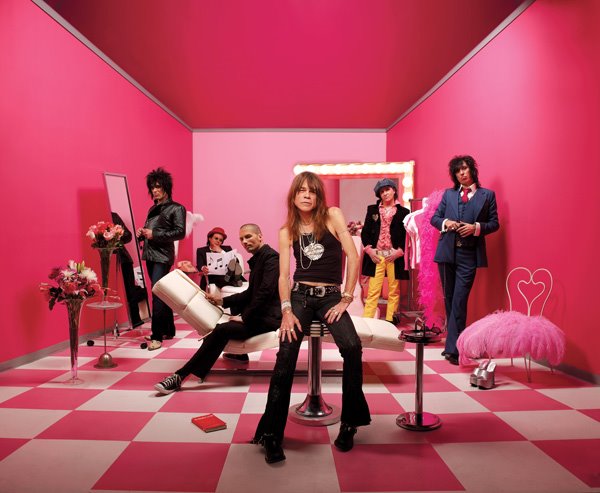
A new record from the New York Dolls is a dicey proposition. 3/5 of the original band are dead, and what they spawned has been so diluted over the decades that trying it again would be like trying to get another cup out of a spent teabag.

Then Steve Scariano let us know that
One Day It Will Please Us To Remember Even This was absolutely great. No, it’s not a New York Dolls record, but it is the best David Johansen solo album ever, and isn’t that reason enough?
Yes.

He goes on to say that “You know if Mike Shelton were here he’d be in everybody’s face, rounds of phone calls, telling us how amazing this record is – go out and buy it, you’ll love it!” Shelton adored David Johansen, seeing him every single time he came to St. Louis, even attending the opening night of Car 54, Where Are You? because he starred in it. Shelton couldn’t convince anyone to see the rotten movie with him, so he went only with his unceasing loyalty to Johansen’s ever-more-curious career moves.

Both Shelton & Scariano are right about the new record: it’s bloody brilliant. Where I disagree with the boys is I
do think it’s a New York Dolls album, undoubtedly and unceasingly.

Based on historical review of a 33-year career, Mr. Johansen has always played a character, worn a costume, trotted out a new musical act for his audience. Transvestite proto-punk, BoHo Chic troubadour, New Wave Mick Jagger, lizard lounge act, ancient white bluesman… He has artfully continued the David Bowie-inspired craft of Musical Chameleon while never requiring the PR fanfare of more calculated practitioners like Madonna.

All these musical personas work because Johansen always comes from a musically pure place. His unceasing fascination and precise historical knowledge of all facets of popular music have always guided him. A New York Doll was the first mask he donned, and he was fortunate enough to have a randy glam boys’ glee club willing to go along with the lark. The Dolls profoundly influencing an important sector of rock music was the divine intervention of being in the right place at the right time. Rather than lessen the achievement, it makes the story that much sweeter.

The Dolls were Chapter One, while Buster Poindexter was Chapter 4, and all his characters are important plot points in Johansen’s musical review. Revisiting the New York Doll character is a gripping plot twist, and David is such a passionate, professional performer that I feel bad for even momentarily doubting that he’d do a disservice to the Dolls legacy. He remembers exactly the Dolls recipe: Chuck Berry, Ellie Greenwhich, Greenwhich Village drag queens, comic books, The Beatles, trash & kitsch culture, urban snark, street punk bravado. Using fresh ingredients, this recipe still works in the hands of the master chef.

The 21st Century New York Dolls philosophy is still irreverent, world weary and joyful. Creationist freaks get humorously poked with “Dance Like A Monkey,” my favorite protest song of the year. On “Plenty of Music,” they revisit The Ronnettes and score 10 points for the use of the word “superfluous” in an era-perfect chorus. The rowdy songs (“We’re All In Love,” “Punishing World,”) uplift, the spiritual songs (“Dancing on the Lip of a Volcano,” “Maimed Happiness”) inspire. Johansen’s lyrics are consistently arch, articulate, and snotty. The 3 new guys are top-notch rockers, and with Johansen and Syl Sylvain leading them astray, it all sounds like a band that’s been goofing off and making music for years. It’s all pure, it all rock, I’m so happy it’s in my life.

And it would be an absolute pleasure to have obsessive conversation about the record with Mike Shelton, but I can’t.

August 2004 Mike, his wife Carrie and his teenage daughter Emily were killed in a freak car accident. They were driving home from Beatlefest in Chicago, when a northbound car crossed the median and slammed into them, instantly killing all 5 people involved. An entire family literally went up in flames, and the shock still lingers like the smell of smoke in your clothes days after a bonfire.

Mike Shelton was the hub that held together the spokes of a musical family. The tires had just blown off the bus and we all crashed hard. Only after he disappeared did we finally realize how large that wheel was, and what a driving force he and Carrie were amongst all St. Louis Rock Obsessed.

The night after their tragic deaths, there was an impromptu wake at CBGB’s. Everyone was dazed and drunk, and tears of abject sorrow turned into tears of bittersweet joy as all the musical loves of Mike’s life played overhead… Bowie, The Beatles, The Stones, Mott the Hoople… every track brought Mike back. Everyone could feel Mike in the room. At one point, the lights went down, the Stooges went up to maximum volume, and an abandoned, tribal dance of celebration took place. The greatest moment of sadness was when they played “Michael Picasso.” Ian Hunter wrote the song as a tribute to his late, great friend Mick Ronson. Ronson was not only Shelton’s greatest musical love, but his personal pal. The ironic karma of Ian’s song to Mick becoming Mike’s song was eerily profound, and even Mike himself broke into tears over how painful our sorrow was.

In the days and months after the Lindsey-Shelton family left, each of us encountered Mike. Whether buying into life after death or deeply cynical about the prospect, each of us had undeniable moments of Mike checking in on us. It was always through the odd placement of a song so poignant and pointed that it defied mere coincidence. He used this same form of communication in both life and death, and each time we experienced it, the message was the same: I’m OK, I’m happy, I’ve still got your back.

The public memorial for Mike Shelton was a benefit concert. Iggy Pop and the The Stooges were Mike’s godhead. The Stooges became The Shemps in the hands of Scariano, Bob Trammel and Craig Petty, and a line-up of Mike pals throughout the decades paraded past the stage, being Iggy for a few minutes (earning the chance to do “TV Eye” is one of the greatest moments in my life). The Duck Room donated the space for the night, a film crew recorded all proceedings, and all of Carrie & Mike’s friends and family gathered for a raucous, magical, cathartic celebration. Mike’s actions in life are a lingering lesson in treasuring your family of choice – your friends. Old connections were renewed, new connections were made, and we’re all still a part of Shelton’s song line.


See memorial concert footage here.

August 2006 The 2nd anniversary of his abrupt exit, so four of us met for brunch before heading to the cemetery to hang around the family headstone. During the meal, Barb suggests that remembering how we each first met Mike would be a nice ceremony.

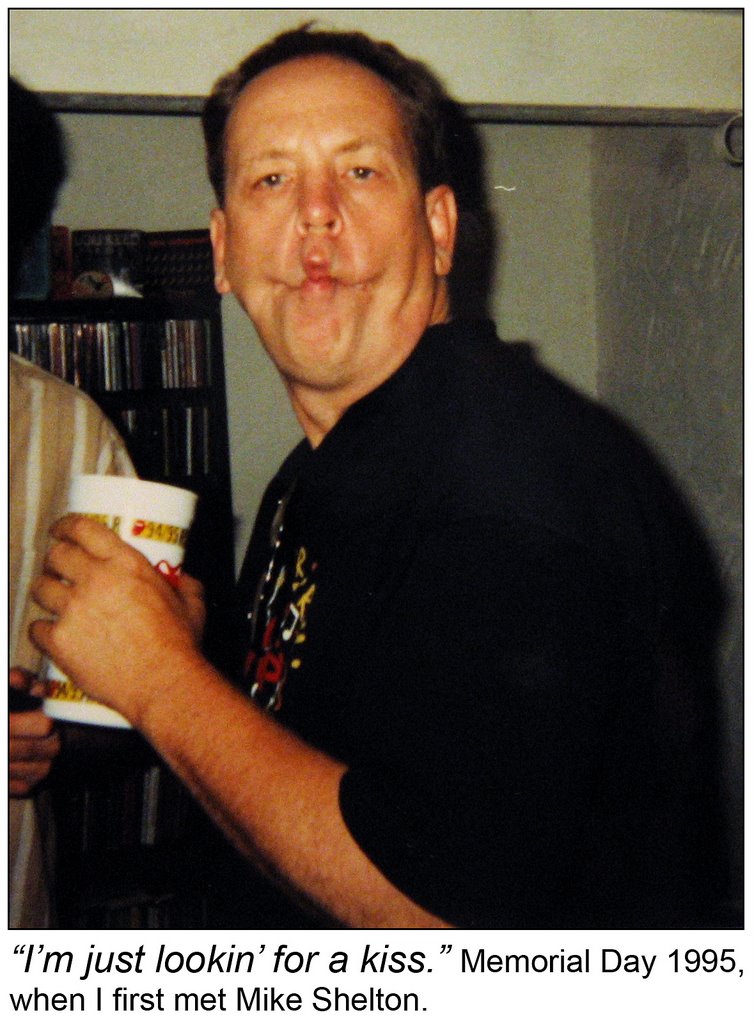
May 1995 Mike & Carrie always threw a Memorial Day BBQ at their home. One year, Mike gave Scariano specific instructions to bring some “new, cool people” to the party. In a case of mistaken identity that resonated like a whoopee cushion, I was recruited and brought along as one of those “cool people.” Within 10 minutes of meeting Mike, he asked what turned out to be his litmus test question: Do you like Mick Ronson?

“Oh yeah,” I told him. “But actually, I love Ian Hunter even more. To show how warped I am, in junior high, I used to fantasize that I was married to Ian Hunter.” Mike fixed me with smiling eyes, and said in all mock seriousness, “So did I, honey. So did I!” From that moment on, he was my source of all Ian Hunter news, as well as the imp who fed me smokes and drinks when I shouldn’t have, and goaded me into listening to albums that I probably never would have.

August 2006 Nowadays, Scariano has taken over Mike’s role of the person who practically forces me to get certain new records, with One Day It Will Please Us To Remember Even This being the latest of his benevolent commands. And every time I listen to the new Dolls CD, it easily conjures Mike Shelton.

We head out to Memorial Park cemetery, and walk up to the family headstone that’s constantly covered with tokens of honor and remembrance. In front of Mike’s plaque, a CD had been inserted into the dirt, like inserting it into a player. Getting up close, I see it’s
the new New York Dolls CD!!!! Turns out Chris left it there a few days earlier; on what would have been Mike’s 56th birthday. Is this not the gift he would want the most?
Yes.

The four of us lounged on the ground in front of the gravestone, as stories, meat cracks and memories of Mike, Carrie & Emily flowed freely. It felt perfectly natural, it felt good. Once back in the car, Scariano did the absolutely natural thing: He rooted in my glovebox and pulled out the new Dolls. Before ever pulling away from the grave site, it cranked out full blast, and roared all the way back home. It was a riotous symphony that allowed for contemplation and sadness. But then that sadness got slapped silly by love and joy and David Johansen basically describing Shelton: “I’m not an artist/I’m a singing, dancing work of art.”

Mike, I love ya, but I can’t miss you if you won’t go away!
Girl, I can’t go away while you’re playing The Dolls!
Mike, this is why I play it everyday.